

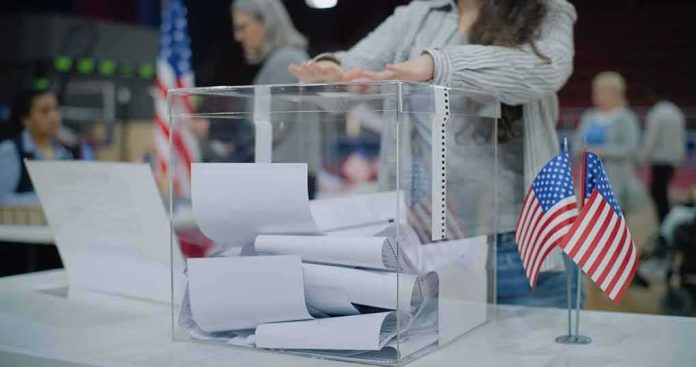
Ballots are supposed to register voter intent, not frustrate it; the Alaska fight over two Dan Sullivans exposes how American election law balances open access to the ballot with the obligation to keep voters from being misled — and why federal courts are wary of rewriting results after the fact.
The Short Version
- The Justice Department asked a federal court to bar Alaska from certifying its U.S. Senate race if the incumbent Republican, Dan S. Sullivan, loses — arguing a same-name challenger could siphon votes through confusion.
- Alaska election officials differentiated the candidates on the ballot using middle initials, an “incumbent” tag, and party labeling asymmetry intended to reduce confusion.
- State courts kept the similarly named candidate, Daniel J. Sullivan Jr., on the ballot, rejecting pre-election efforts to remove him while leaving mitigation to ballot design.
- The legal crux is recurring: protect voter access and ballot neutrality while preventing sham candidacies that distort intent — without inviting federal micromanagement of state certification absent clear violations.
What the Alaska dispute is really about: voter intent versus ballot access
The Justice Department’s lawsuit does not claim hacking, tabulation error, or mass ineligibility. Its theory is more elemental: in a ranked-choice contest, some number of Alaskans who mean to support Senator Dan S. Sullivan could accidentally select Daniel J. Sullivan Jr., altering the elimination and transfer math that ultimately decides the winner. The complaint’s own example — “some supporters of Senator Sullivan likely will inadvertently vote for Daniel J. Sullivan” — crystallizes the asserted harm: misdirected first-preference votes affecting later counts in the instant-runoff sequence. That mechanism is plausible in principle. It is also hard to measure ex post without re-interpreting ballots based on speculation about what a voter “really” meant.
Election administration has long treated similar-name and “nuisance” candidacies as a category of risk — not because identical names are illegal per se, but because the ballot is a blunt instrument. The law’s duty is twofold: keep the ballot open to bona fide candidates and keep it legible so voters can identify their choice. Where the system falters, the remedy should reinforce intent without disenfranchising lawful votes. That is the standard that governs whether extraordinary relief — such as halting certification — is warranted.
How Alaska tried to mitigate confusion on the front end
Alaska’s Division of Elections leaned on design and labeling. The ballot presents “Dan S. Sullivan” with both his middle initial and an “incumbent” designation, alongside a Republican identifier, while listing “Daniel J. Sullivan Jr.” without a party label. Officials expect these cues — the middle initials, the incumbency marker, and the asymmetry in party labeling — to signal which name refers to the sitting senator and which does not. This is conventional mitigation: when two candidates risk confusion, use unambiguous descriptors voters already recognize. Media reporting across outlets consistently described these steps as intentional efforts to reduce mix-ups at the point of selection.
Critically, Alaska’s ranked-choice system also tempers the worst-case scenario. If a voter is uncertain and ranks the two Sullivans first and second, those preferences do not “split” in the traditional first-past-the-post sense; if the less-supported Sullivan is eliminated, that ballot transfers to the other Sullivan rather than exiting the count. That does not eliminate risk — a mistaken first ranking can still influence the timing of eliminations — but it reduces the chance that confusion alone deprives a voter’s general preference for the incumbent of effect.
What the courts already did — and did not — decide
The Alaska courts faced a threshold question months earlier: should Daniel J. Sullivan Jr. be kept off the ballot as a sham? They said no, leaving him on and directing elections officials to differentiate clearly on the ballot. That resolves candidacy access but not the federal question the DOJ now presses: whether certification can proceed if the similar-name dynamic plausibly distorted intent. The DOJ is not relitigating state candidacy qualifications; it is seeking a federal injunction delaying certification to permit an inquiry into voter intent tied to ballot confusion.
That is a steep hill. Federal courts are reluctant to halt state certification in the absence of a concrete federal-law violation and a workable remedy that does not itself disenfranchise voters. The ask here implies post hoc divination: investigate whether votes for Daniel J. Sullivan were “meant” for Dan S. Sullivan and then adjust outcomes or certification accordingly. The practicality problem is obvious. Ballots are secret by design; voter interviews are unreliable; and reassigning lawful votes based on inferred intent risks creating more error than it corrects. Those difficulties are among the reasons legal analysts have called the DOJ’s posture precarious.
The core evidence on both sides — weighed
The DOJ’s strongest point is specificity: the names are unusually similar, the candidates compete for the same office, and even a small number of miscast first-preference votes can change an instant-runoff path. The complaint quotes the likely-error mechanism directly; it is not speculative in structure, only in magnitude. In close elections, small perturbations can be decisive, and election law has recognized that ballot design and clutter can drive measurable voter error in other contexts, such as overvotes tied to poor layout.
The counter-case offers more concrete, front-end facts. Alaska structured the ballot to distinguish the candidates — middle initials, incumbency, and party labeling — and did so precisely to mitigate confusion. State and state-court processes preserved access to the ballot while curbing risk through presentation, rather than through exclusion. And ranked-choice mechanics allow a confused but cautious voter to rank both Sullivans, preserving the prospect that a preference for the incumbent ultimately counts if the other Sullivan is eliminated. On the record available, there is no quantified evidence of actual confusion rates or their outcome effect; the case turns on possibility, not measured harm. On that score, the mitigation measures are tangible, while the asserted injury remains theoretical.
What a sensible remedy looks like in similar-name disputes
Seasoned election administrators favor prophylaxis over post hoc surgery. When similar-name candidates appear, the best practice sequence is: 1) verify good-faith candidacy; 2) differentiate clearly on the ballot using middle names, incumbency, and party cues; 3) educate voters in sample ballots and PSAs; and 4) preserve ordinary avenues for recounts and contests that rely on countable facts, not reconstructed intent. Only in the rare case where a sham candidacy or deceptive design is proven — with evidence of intent to confuse and observable effects — should officials consider extraordinary remedies that would pause certification or reallocate votes. Alaska largely followed that playbook on steps one through three; the DOJ seeks to extend it into step five without new evidence that steps two and three failed at scale.
The caution here is not procedural fetishism; it is fidelity to voter sovereignty. If the system invites after-the-fact reassignment of lawful marks to a different candidate based on similarity of names, it risks undermining the certainty that every voter’s literal selection is what gets counted. The better long-term safeguard is to harden front-end design standards — for example, making incumbency and party cues uniform and prominent when similar-name candidates appear — while keeping back-end remedies tethered to verifiable facts like tabulation error or ineligible ballots.
🚨 ALASKA SENATE SHOWDOWN!
The DOJ is fighting to block certification of a narrow defeat for Republican Sen. Dan S. Sullivan, warning that a second candidate with nearly the SAME NAME could confuse voters.
Two Dan Sullivans. One Senate seat. A major legal battle.
Is this voter…
— Xi Znping (@XiZnping) October 27, 2026
The broader lesson: design away foreseeable confusion, litigate only what you can measure
Similar-name candidacies are uncommon but not unheard of. They stress-test whether our systems honor intent in the face of foreseeable, designable risk. Alaska’s case underscores two durable principles. First, ballot presentation matters; subtle cues like middle initials and incumbency tags do real work guiding voters to the person they recognize. Second, litigation is a blunt instrument for reconstructing intent once ballots are cast. Absent evidence that confusion occurred at a scale plausibly altering the outcome, courts will — and should — hesitate to freeze certification while officials try to read minds. The cleanest elections are won at the design table before anyone steps into a booth, not in courtrooms after the count.
Sources:
npr.org, washingtonexaminer.com, cbsnews.com, alaskasnewssource.com, electionlab.mit.edu, anycase.ai