

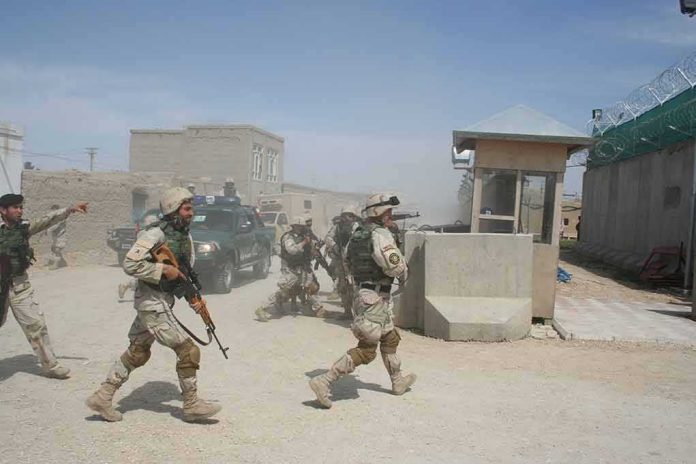
Egypt’s top security body has approved sending troops to Saudi Arabia to help defend the kingdom against intensifying Houthi missile and drone attacks, pushing one of the Arab world’s largest militaries toward its first direct role in Yemen’s war.
Story Snapshot
- Egypt’s National Defence Council approved a defensive military deployment to Saudi Arabia on Sunday, October 18.
- President Abdel Fattah al-Sisi asked parliament for authorization after Houthi forces hit Riyadh’s airport and a Saudi Aramco facility.
- Egypt’s constitution requires a two-thirds parliamentary vote before any troops leave the country on a combat mission.
- Lawmakers delayed the final vote to Monday, meaning no Egyptian forces have been confirmed on Saudi soil yet.
Council Approves Defensive Mission
Egypt’s National Defence Council met Sunday evening at Al-Ittihadiya Palace in Cairo, bringing together President Abdel Fattah al-Sisi, the prime minister, the defense minister, intelligence chiefs, and the armed forces chief of staff. The council approved what it called “all necessary and possible forms of support” to protect Saudi Arabia’s security, resources, territory, and Islamic holy sites.
Egyptian lawmaker Mostafa Bakry, a member of parliament known for close ties to the state, said on social media that the council had specifically approved sending forces to Saudi Arabia on “a defensive mission”. The presidency’s own public statement, however, stopped short of mentioning troops directly, describing only broad support.
Houthi Attacks Drove The Request
The push for military backing follows a sharp rise in Houthi strikes on Saudi territory. Houthi forces, who control northwestern Yemen, hit Riyadh’s international airport and the headquarters of Saudi Aramco, the world’s largest oil company, within the same week, exposing gaps in Saudi air defenses despite the kingdom’s advanced Patriot and Terminal High Altitude Area Defense systems. Those attacks prompted President Sisi to formally ask Egypt’s parliament to authorize defensive measures.
Analysts tracking the region say the strikes renewed questions about whether Gulf states need a broader regional security framework, since Saudi Arabia’s own defenses have struggled to stop the attacks. That vulnerability is part of why Cairo’s offer carries weight beyond a single country’s military calendar.
Constitution Sets A High Bar
Egypt’s constitution makes this process more than a formality. Article 152 states the president cannot send armed forces on a combat mission outside the country without first consulting the National Defence Council and then winning approval from two-thirds of parliament’s members. That rule exists specifically to prevent a single leader from committing troops abroad without broad political buy-in.
Egypt’s House of Representatives opened an emergency, closed-door session Sunday to debate the request, then adjourned without a final vote. Two lawmakers told Agence France-Presse the vote was pushed to Monday so members would have more time to debate the details. A later report confirmed parliament had not yet approved the authorization as of that delay.
I’ve seen some pretty funny comments claiming Egyptian troops have already deployed to Saudi Arabia because two C-130 transports landed there. Guys, relax. Two C-130 flights don’t mean a troop deployment is underway. These are routine support flights that have been taking place… https://t.co/ZzzFlF3blh
— Egypt's Intel Observer (@EGYOSINT) October 19, 2026
That delay matters because it means no deployment has legally taken place yet. One analysis of the process noted plainly that the council’s approval “does not constitute an immediate troop deployment,” since parliamentary authorization is still required to complete the legal steps. The distinction between a defensive mission and direct combat involvement remains central to how Egypt is framing its role.
What This Signals Regionally
If approved, Egyptian forces would become the first foreign army to join Saudi Arabia’s defense against Houthi attacks in any formal capacity, a step that would mark a shift in how Arab states coordinate against threats from Yemen. Egypt’s National Defence Council statement described “full solidarity” with Saudi Arabia, language that goes well beyond a routine diplomatic gesture.
For ordinary Americans watching oil markets and Middle East stability, the stakes are straightforward. A wider Gulf conflict risks disrupting energy supplies and drawing more countries into a fight that started in Yemen’s civil war. Egypt’s parliament is expected to revisit the vote, and the outcome will determine whether Cairo’s pledge turns into troops on the ground or remains a political commitment on paper.
Sources:
zerohedge.com, siasat.com, thenationalnews.com, africaupdates.com, asiatoday.id, warinfohub.com, south24.net