

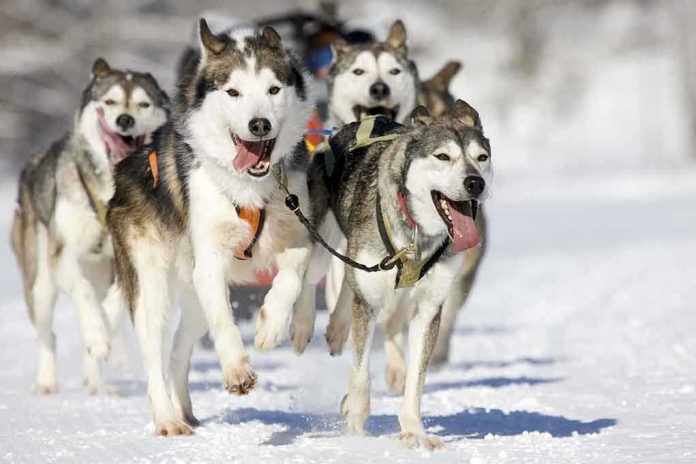
Survival in avalanche country is usually measured in minutes; LouLou, a four-year-old poodle–husky mix, made it through roughly two days in Alaska’s high country and came home because people and simple technology worked in concert.
At a Glance
- An avalanche on October 10 near Pepper Peak/Eklutna Lake in Chugach State Park separated LouLou from her owner during a mountaineering outing.
- Volunteer helicopter pilots visually located the dog after about 50 hours in the snow and reached her on foot; she was alert and responsive.
- An Apple AirTag on LouLou provided a search clue that helped narrow the area of interest, though final discovery was by sight from the air.
- Multiple outlets independently reported the rescue with consistent core details; minor variations concern precise duration and post-rescue condition.
What Happened on the Mountain
The sequence is straightforward and, in the broad strokes, consistently reported. On Saturday, October 10, a slide released on or near Pepper Peak above Eklutna Lake in Chugach State Park, sweeping two mountaineers downslope and separating them from their dog, LouLou. Over the next two days, a volunteer-led search coalesced. A helicopter team—identified in several accounts as Amanda Barker and Dave Beckett—flew the terrain and eventually spotted a dog standing in the snow below, within the wider zone where she had last been with her owner. The pilots set down at a safe landing site and, after a hike of approximately twenty minutes over winter surface conditions, reached LouLou. She was reported to be alert and barking when called by name, a good field sign in an animal potentially exposed to cold stress.
Duration is best understood as “about two days.” Some outlets say “two days” or “about 50 hours,” and one says “more than 50 hours,” which are functionally equivalent characterizations of the same window from avalanche to reunion. The coordinate details in public reporting place the incident within a familiar corridor of avalanche terrain for Southcentral Alaska: steep alpine slopes and gullies above Eklutna Lake, where early-season conditions can be deceptive—shallow snowpacks can still slide, and a dusting over old crusts can create fast-running slabs. The story’s power is not in a miraculous anomaly; it is in a plausible chain where exposure, terrain, and search craft all mattered.
How the Search Found Its Focus
The search combined local knowledge, air support, and a modest piece of consumer electronics. LouLou was wearing an Apple AirTag, which became a critical clue. AirTags do not have GPS radios; they broadcast a low-power Bluetooth signal that is opportunistically relayed by nearby Apple devices through the Find My network, updating the item’s last-seen location when another phone or computer passes within range. In urban settings, that can mean near-real-time dots on a map; in alpine Alaska, where iPhones are scarce, updates are intermittent at best. Even so, the AirTag’s last-known ping helped frame a search box that pilots could sweep visually, after which trained eyes did the essential work of picking out a small animal on a large, monochrome canvas.
A point of confusion in some public conversations about AirTags is precision. Apple’s “Precision Finding” feature uses an iPhone’s ultra-wideband chip to guide you to an AirTag within a room; that is not how long-range recovery works. When you are farther away, an AirTag’s position is only as fresh and accurate as the last nearby Apple device that heard it, which means rural pings can be approximate or stale. That limitation squares neatly with reports noting that an estimated location helped, but the helicopter team still had to fly, look, land, and walk to complete the rescue.
Why LouLou’s Survival Is Plausible
Avalanches kill by two main mechanisms: trauma on the ride and asphyxiation under debris. Timelines for buried victims are brutal—survival rates are high if extrication happens within 15 minutes, then collapse dramatically past the half-hour mark as oxygen and airway patency fail. But LouLou’s case, as described, does not read like a classic complete burial with prolonged entrapment. The more likely scenario is separation during or immediately after the slide, followed by exposure in severe but survivable ambient conditions for an arctic-adapted cross like a poodle–husky. Those breeds carry dense, insulative coats and strong cold tolerance; a dog that avoids significant trauma and finds even a marginal lee from wind can conserve core heat far longer than a human in wet layers. In that context, “two days out” is not an outlandish outcome—it is the kind of edge-case survival that rewards fast mobilization and luck.
Rescue-dog and avalanche literature underscores the time sensitivity of true burials and the complementary roles of technology and dogs in organized response. Those data, often drawn from ski-area incidents and European snow science workshops, help anchor expectations: electronics can speed location when a transceiver or networked tag is present; helicopters and human searchers remain decisive in big terrain. LouLou’s case demonstrates the same principle in civilian backcountry terms: a simple tag suggested a place; airmanship and foot travel did the rest.
The People Who Made It Happen
Volunteer aircrews are a quiet backbone of many mountain rescues, particularly when weather, daylight, and distance conspire against ground teams. Reports credit pilots Amanda Barker and Dave Beckett with the aerial spot and the on-foot approach that closed the final distance to LouLou. Their work fits a familiar pattern in Alaskan rescue culture: experienced private aviators, often in coordination with local search-and-rescue networks, bridge the gap between a probable area and a confirmed find when speed matters. Television coverage adds an eyewitness coda—on-site accounts describe a dog who still had the energy to bark when she heard her name, a small but telling detail about her physiological reserve after two days exposed.
Other participants likely contributed—some reports reference a broader volunteer cohort, including drones and a tracking dog—but the publicly consistent through-line is the helicopter search, the AirTag clue, and a successful, conservative landing followed by a short ground approach. That is exactly how you manage risk in hangfire terrain after a slide: use altitude and eyes to minimize exposure, land where the snowpack and slope angles are benign, and finish the job on foot.
A dog survived an avalanche and 50 hours alone
LouLou, a poodle–husky mix, disappeared after an avalanche in Alaska swept away two mountaineers. More than 50 hours later, a determined rescue team found the dog alive and largely uninjured. pic.twitter.com/D9FpHpHc5o
— Soul Pearls 🪷 (@SoulPearlsss) October 16, 2026
What This Means for Backcountry Travelers with Dogs
Two practical lessons emerge. First, redundancy matters. An AirTag is not a GPS tracker, but it is light, inexpensive, and—when any Apple device wanders into range—capable of leaving a useful breadcrumb that focuses scarce search hours. In low-density areas, it will not lead rescuers to within meters on its own; paired with educated search planning and, if available, aircraft or drones, it may be enough to make the difference between a needle-in-haystack sweep and a targeted pass that catches a visual. Second, canine exposure is survivable when trauma is avoided. A robust, well-coated dog that is not buried can last in the cold longer than many owners assume; that is not license to be cavalier about avalanche terrain, but it is a reason to mobilize rapidly and not give up if immediate results do not come.
The coda to LouLou’s story is simple and reassuring. In a landscape where minutes usually determine outcomes, a chain of basic, well-understood tools—community pilots, methodical aerial search, cautious ground approach, and a consumer tag—produced a live reunion after about two days in the snow. That is not a miracle. It is competence, leveraged where it counts.
Sources:
facebook.com, accuweather.com, people.com, foxweather.com, timesofindia.indiatimes.com, ndtv.com, discussions.apple.com, slf.ch, saminfo.com