

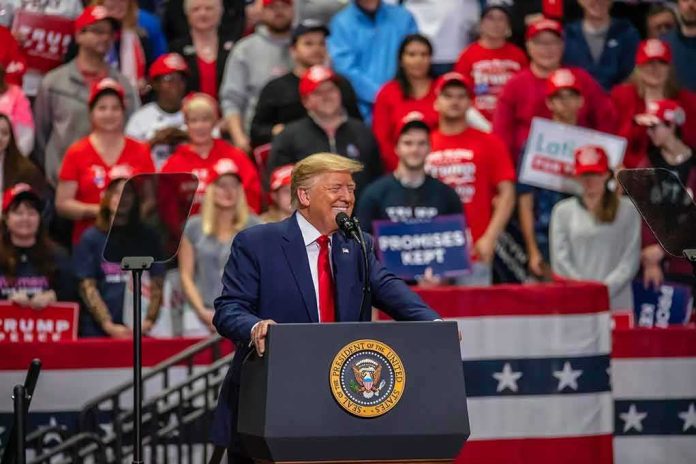
When the president turns the Oval Office into a live Wall Street stage, it raises real questions about who the financial system is built to serve.
Story Snapshot
- Officials from the New York Stock Exchange and Nasdaq will ring a joint opening bell from the Oval Office to launch new child investment “Trump Accounts.”
- Trump Accounts promise $1,000 in government seed money and tax-deferred growth for children born between 2025 and 2028, with extra private contributions possible.
- Key rules and funding details exist in draft form at the Treasury and Internal Revenue Service, but many practical questions and safeguards remain unclear.
- The event merges presidential power, Wall Street symbolism, and children’s futures, feeding broad public worries about an elite system that often fails everyday families.
Trump Brings Wall Street’s Opening Bell Into the Oval Office
White House National Economic Council Director Kevin Hassett told CNBC that, for the first time ever, officials from both the New York Stock Exchange and Nasdaq will ring their opening bells from the Oval Office. He described it as a “big opening bell ceremony” designed to celebrate new Trump Accounts and make sure “everybody knows it’s time to get an account for your kid, even if it’s not born this year.” The joint ceremony turns a routine market ritual into a presidential showpiece centered on a single program.
Trump has used stock market milestones and ceremonies before to signal economic strength, including ringing the New York Stock Exchange opening bell in December 2024 before his second term. But bringing both exchanges into the Oval Office marks a new level of blending presidential image-making with Wall Street branding. For Americans who already feel the financial system favors insiders and big firms, this made-for-TV moment may look less like help for families and more like a reminder of who sits closest to the money.
What Trump Accounts Promise for Children and Families
Trump Accounts are described as Individual Retirement Account-style savings accounts for United States citizens under age 18, with tax-deferred growth and limits on withdrawals until adulthood. Under the program, the United States Treasury is expected to deposit $1,000 in seed money for each child born between 2025 and 2028 who has a valid Social Security number. Families can start contributing on July 4, with annual family deposits up to $5,000 and employer deposits up to $2,500 per child until age 18.
Internal Revenue Service and Treasury documents tied to the “One Big Beautiful Bill” lay out proposed rules for opening the first Trump Accounts. These draft regulations explain how financial firms should verify identity and immigration status, and how accounts tie into a broader effort the White House calls “Restoring Integrity to America’s Financial System.” The administration says the goal is to give children “a stake” in the economy from birth, but no public data yet shows how often families are expected to participate, or what typical account balances might look when those children turn 18.
The Legal and Financial Framework Behind the Show
Several executive orders and Treasury resources suggest Trump Accounts sit inside a wider push to reshape how banks and regulators treat customer risk, including immigration status and federal benefits. The Treasury’s implementation pages on “America’s Bank Account” and related orders show a complex network of rules, but they do not yet give a simple, plain-language roadmap for parents trying to understand Trump Accounts. That gap between legal detail and public explanation feeds doubts among both conservatives and liberals about who really benefits when Washington rewires the financial system.
Media reports note that, beyond Hassett’s broadcast interview and press stories, there is still no widely circulated, final executive order or Treasury directive spelling out the exact funding mechanism and protections for Trump Accounts. The White House also did not give immediate detailed comment when pressed by reporters, suggesting communication is playing catch-up with the Oval Office ceremony. For families who remember past programs that sounded good but were hard to access, this mix of big promises and limited public documentation feels familiar and frustrating.
Symbolism, Trust, and the “Deep State” Worry
Historians and analysts have long noted how presidents use public rituals—like signings, inaugurations, and staged announcements—to project power and shape national symbols. This joint bell ringing fits that pattern: it wraps Wall Street, the presidency, and children’s financial futures into one image of economic confidence. Yet research on stock markets shows that overall returns do not strongly track which party is in power, reminding us that markets follow many forces beyond a single leader or photo op.
Trump rings NYSE and Nasdaq opening bells from the Oval Office—a first for any president. Unconventional move blending markets and executive power in signature style. #WallStreet #Trump #StockMarkethttps://t.co/yqbLNc0Iyk
— @GlobalRightWatch (@AutonomusRepost) July 3, 2026
Americans on both the right and left now share a deep worry that the federal government mostly serves the rich and well connected. Many see “the deep state” not just as shadowy officials, but as a tight web of big banks, tech firms, and political insiders who seem to play by different rules. When the Oval Office becomes a stage for Wall Street’s opening bell, while regular families still fight inflation, high housing costs, and weak savings, that worry can only grow.
What Comes Next for Families Watching This Rollout
For parents and grandparents trying to decide whether Trump Accounts are a real opportunity, the key questions are simple. How easy will it be to open and manage these accounts? What protections exist if markets drop or if fees eat into that $1,000 seed money? And how will this program interact with existing savings tools and benefits they already use? Proposed rules from the Internal Revenue Service and Treasury offer some answers, but they are written for lawyers, not for busy families.
Independent audits of the Treasury deposits, clear public rules on eligibility, and plain-language guides to costs and risks would go a long way toward building trust. So would honest studies from non-partisan researchers on whether programs like Trump Accounts really help close the gap between wealthy households and everyone else. Until that happens, the image of both Wall Street bells ringing from the Oval Office may feel less like a victory for the American Dream and more like another reminder that the system is still run from the top down.
Sources:
bloomberg.com, finance.yahoo.com, cnn.com, youtube.com, mayerbrown.com, irs.gov, whitehouse.gov, ballotpedia.org, federalregister.gov, nytowns.org, usbank.com, heritageconsultants.com, facebook.com