
As missiles fly and threats escalate, both Washington and Tehran claim self-defense while the risk of a wider war — and higher energy costs — lands on American families.
Story Snapshot
- U.S. Central Command said it struck Iranian air defenses and radar after an Apache was downed [2].
- Iran’s Revolutionary Guard said it hit U.S. sites in Bahrain, Kuwait, and Jordan in response [4].
- A U.S. official said nearly 20 Iranian targets were hit; most Iranian missiles were intercepted [4].
- Both sides frame their actions as self-defense, putting a fragile ceasefire and talks at risk [3].
What Triggered The Exchange Near The Strait Of Hormuz
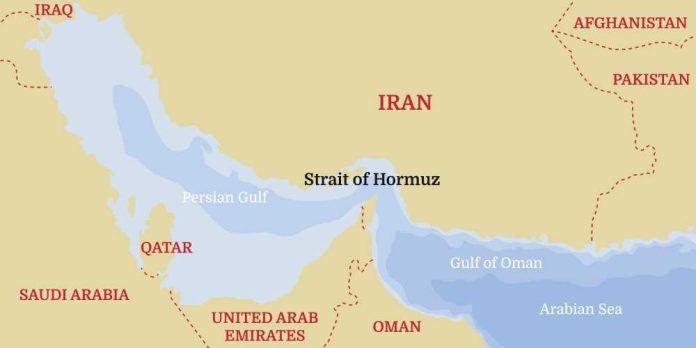
U.S. Central Command said American forces carried out self-defense strikes on Tuesday evening after a U.S. Army Apache helicopter was downed near the Strait of Hormuz. The command said the operation targeted Iranian air defense, ground control stations, and surveillance radar sites, and called it a proportional response ordered by the president at about 5 p.m. Eastern time [2]. A senior U.S. official told reporters the helicopter had been brought down by a one-way Iranian attack drone, and both crew members were rescued later at sea [4].
Iran’s Islamic Revolutionary Guard Corps said it answered with drone and missile attacks on U.S. facilities across the Gulf. Its statements cited targets in Bahrain, Kuwait, and Jordan. Initial American assessments suggested most incoming weapons were intercepted and there were no immediate reports of injuries to U.S. personnel or serious damage to U.S. bases, according to a U.S. official quoted after the exchanges [4]. The back-and-forth followed months of tense encounters around the narrow waterway that carries a large share of the world’s oil.
Competing Claims Of Self-Defense And The Ceasefire Strain
U.S. officials framed the strikes as a limited warning and a lawful self-defense action tied to the shootdown and to recent threats to shipping lanes. The military said Air Force and Navy jets used precision munitions against sites tied to Iranian surveillance and air defenses near the strait [2]. Iran’s leaders insisted the U.S. violated an existing ceasefire with the new strikes and warned that further American action would halt diplomacy, even as they claimed fresh attacks against U.S. sites in the Gulf region [7]. Media in the region reported growing fears of a broader conflict [3].
Specific battlefield claims also diverged. Washington said a one-way Iranian drone brought down the Apache during a patrol near Oman’s coast and that the crew was recovered in stable condition [5]. Iran-linked outlets portrayed their actions as defensive responses to U.S. aggression and at times floated larger loss claims that U.S. officials disputed in briefings and posts. With both sides pushing their narratives, independent confirmation of several tactical details remains limited amid active combat and information control [3].
Why This Matters For Americans Watching Prices And Promises
The Strait of Hormuz is a choke point for global oil. When fighting rises there, fuel markets get nervous, and families feel it at the pump. The U.S. military said the goal was to protect shipping and deter more attacks, not start a wider war [2]. Iran’s warnings, and its claimed strikes on regional U.S. hubs, raise the odds that new disruptions could ripple into supply chains. Even if most missiles are intercepted, insurers, shippers, and traders often price in risk quickly, which can push costs higher [4].
Americans across the political spectrum share a core worry here: leaders promise safety, steady prices, and clear goals, yet crises keep repeating with murky facts and shifting red lines. People who distrust “the system” see another cycle where officials speak of precise, proportional moves while the region inches toward a bigger fight. The gap between Washington’s assurances and lived costs at home fuels that distrust. Until both sides lock in verifiable limits, this pattern — and the pressure on wallets — will likely continue [3].
Sources:
[2] Web – US-Iran Ceasefire Teeters After Trump’s Strikes and Tehran’s …
[3] Web – ‘Unjustified Iranian aggression’: US launches strikes on Iran after …
[4] YouTube – US Strike Iran Live News: US Bombs Iran After Apache Downing Near …
[5] Web – Iran strikes US bases in Gulf after Trump orders attacks near Hormuz
[7] YouTube – Gulf Explodes: US Strikes, Iran Hits Back| Trump Says Blow Up Oman, …