

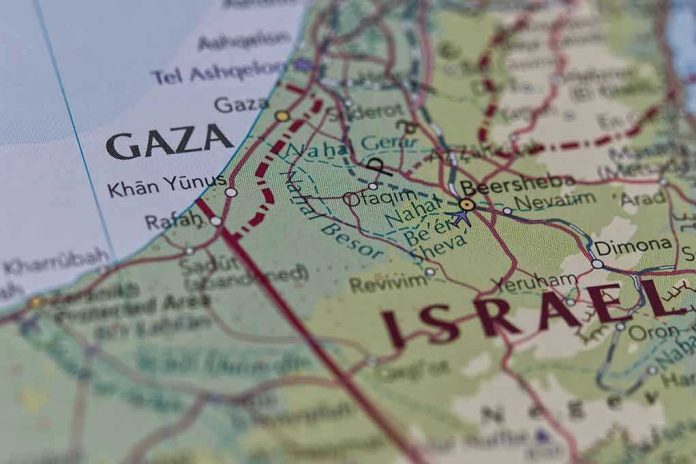
Israel’s regional dominance reshapes the Middle East, challenging Iran and redefining alliances.
Story Highlights
- Israel’s proactive security strategy elevates its influence in the Middle East.
- U.S. retrenchment allows Israel to strengthen regional alliances through the Abraham Accords.
- Iran’s influence wanes as Israel’s technological supremacy secures its position.
- Ongoing operations in Gaza and against Hezbollah bolster Israel’s security architecture.
Israel’s Strategic Ascendancy
Following the October 7, 2023, Hamas attack, Israel shifted from a defensive stance to a proactive regional strategy. By leveraging advanced military technology and intelligence capabilities, Israel has positioned itself as a central figure in Middle Eastern security.
As the U.S. reduces its direct involvement, Israel steps up as a regional hegemon, reshaping the power balance and countering Iranian influence. This strategic evolution underscores Israel’s commitment to regional security while navigating the complexities of new alliances.
The Abraham Accords have been pivotal in Israel’s strategy, fostering deeper ties with Gulf states. This expansion of regional partnerships underscores a shift in Middle Eastern dynamics, where Israel’s network-centric security model plays a crucial role.
As Iran-backed groups face degradation, Israel’s influence grows, with ongoing operations in Gaza and against Hezbollah further consolidating its position. This transformation highlights a strategic recalibration in response to evolving threats and opportunities.
The Role of U.S. Retrenchment
The decline of U.S. direct involvement in the Middle East has created a power vacuum that Israel has adeptly filled. Under President Trump’s administration, the U.S. emphasizes burden-sharing, entrusting Israel as a primary regional security provider.
This shift allows Israel to assert greater autonomy and influence, particularly concerning Iran’s diminishing regional strategy. The U.S. continues to support Israel’s role, aligning with its objectives of containing Iran and expanding the Abraham Accords.
Saudi-Israel normalization remains a critical issue, with progress contingent on Palestinian statehood discussions. While the Gulf states benefit from security cooperation with Israel, domestic backlash over normalization persists.
Nevertheless, Israel’s integration into regional energy and technology networks enhances its strategic leverage, positioning it as a cornerstone of Middle Eastern stability. This dynamic reflects broader geopolitical shifts and the recalibration of traditional alliances.
Implications for the Region
Israel’s ascendancy brings both opportunities and challenges. In the short term, Israel’s enhanced security influence weakens Iranian proxies and stabilizes its borders. However, the long-term implications depend on addressing Palestinian statehood and navigating regional tensions.
As Israel’s dominance grows, it must balance its security interests with diplomatic challenges and international scrutiny. The potential for a durable Israel-led security order exists, contingent on strategic diplomacy and regional cooperation.
The integration of defense, intelligence, and energy projects with regional partners underscores Israel’s strategic vision. This approach not only bolsters security but also redefines the Middle Eastern landscape, aligning with conservative values of strong national defense and strategic autonomy.
As Israel continues to navigate this complex geopolitical environment, its role as a regional leader offers both stability and new challenges in the evolving Middle East order.
Sources:
JURIST: The Shifting Balance of Power in the Middle East
Solace Global: Middle East Instability 2025
Steptoe: Israel in 2025 – Perspectives on a Region in Turmoil
Wilson Center: Political Swings in the Middle East 2025