

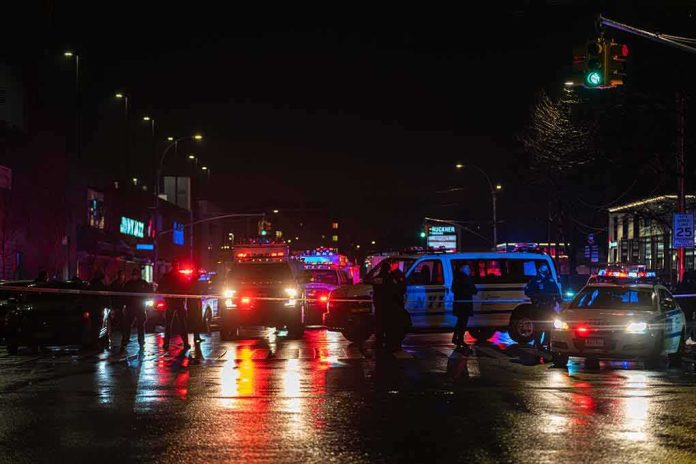
One dead and seven more in the hospital is the latest warning that Washington, D.C., still cannot get the fentanyl crisis under control.
Quick Take
- Police said eight people had suspected overdoses on H Street Northeast, and one died at the scene.
- First responders treated the victims after reports of multiple unconscious people, and officers used Narcan on several of them.
- D.C. recorded 3,125 overdose deaths in 2024, which the report said is one of the highest per-person rates in the nation.
- Officials and past reports have tied many D.C. deaths to fentanyl, but the new H Street case has no lab confirmation yet.
H Street Incident Raises Fresh Alarm
Police and fire crews responded around 1:45 p.m. Thursday to the 900 to 1400 blocks of H Street Northeast after reports of multiple unconscious people. One person was pronounced dead at the scene, and seven others were treated or taken to the hospital. Officers also gave Narcan to several victims, which shows how fast these scenes can turn deadly when opioids are involved.[1]
The city’s overdose problem is not new. Townhall reported that D.C. recorded 3,125 overdose deaths in 2024, a number described as one of the highest per-person rates in the country.[1] That is the kind of figure that should force city leaders to face a hard truth: years of talk, programs, and press events have not stopped drug deaths from hitting families across the capital.
A Crisis Built Around Fentanyl
Past city data points to fentanyl as the main driver behind the death toll. The District of Columbia Office of the Chief Medical Examiner’s 2021 annual report found that fentanyl was involved in 95 percent of opioid deaths, and deaths rose from 83 in 2014 to 422 in 2021.[12] That is a brutal rise, and it matches what federal drug officials have warned for years about fentanyl taking over the illegal drug market.[17]
At the same time, the new H Street incident has limits. Police described it as a suspected overdose event, not a lab-confirmed fentanyl case. That matters because the public deserves facts, not assumptions, when a death is already under investigation. The broader trend is clear, but the exact cause in this case still needs toxicology results before anyone should claim certainty about the substance involved.[1][12]
Why the Response Still Matters
Washington, D.C., has seen repeated overdose clusters, including earlier reports of multiple deaths in Northeast neighborhoods and deadly fentanyl events near Nationals Park and Navy Yard. Those cases helped fuel the view that the city is dealing with a recurring street-level poison problem, not isolated bad luck.[2][4] When police keep finding clusters in the same city, voters have every right to ask whether current policy is saving enough lives or merely managing the wreckage.
The larger national picture backs that concern. The Centers for Disease Control and Prevention says opioid-involved deaths rose sharply for decades, though 2023 brought the first annual decline since 2018.[8] Even so, Washington still posted a very high fentanyl death rate in national tracking, and the drug remains a major force in overdose deaths across the country.[24] That mix of decline and danger means officials cannot treat any local cluster as routine.
Public Safety and Common-Sense Policy
For conservative readers, the lesson is simple: weak borders, easy drug access, and soft enforcement have real human costs. Naloxone saves lives, but it does not fix the supply chain that keeps flooding streets with lethal drugs. Federal and local agencies have to keep pressure on traffickers while also making sure first responders, families, and communities have the tools to stop deaths before the ambulance arrives.[17][9]
7 taken to the hospital, 1 dead after mass overdose in Northeast DC. https://t.co/dLNbMBCSxk
— ELLIOT IN THE MORNING (@EITMonline) June 26, 2026
DC Policy Center has argued that the city faces a heroin and fentanyl crisis more than a broad opioid crisis, and it has pushed fentanyl test strips and medically assisted treatment as part of the answer.[9] Those tools may help, but they do not replace accountability for dealers or leaders who let the problem grow. The latest H Street deaths are another reminder that the capital still needs stronger enforcement, faster response, and less political spin.
Sources:
[1] Web – One Dead After Eight People Overdose While DC Struggles to Combat …
[2] Web – 10 Dead From Drug Overdoses In Northeast DC Over Past 3 Days: Police
[4] Web – Mass fentanyl overdose deaths linked to drug deals near Nationals …
[8] YouTube – Suspects Accused of Dealing Lethal Batch of Drugs in DC | NBC4 …
[9] Web – Confronting the opioid—and fentanyl—crisis in the District
[12] Web – OPIOID
[17] Web – DEA Warns of Increase in Mass-Overdose Events Involving Deadly …
[24] Web – Are fentanyl overdose deaths rising in the US? – USAFacts