

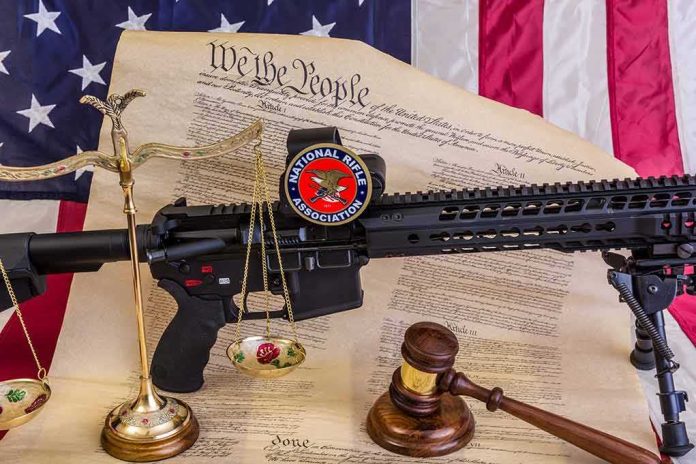
When Congress zeros out the tax that once justified a federal regulatory machine, the Constitution does not let the gears keep turning on momentum alone; that is the core insight behind a Texas ruling that shutters National Firearms Act registration and approval requirements for suppressors and certain short‑barreled firearms—at least for the parties before the court—and it explains why the case matters far beyond gun policy.
At a Glance
- The Northern District of Texas held that NFA registration and approval rules for untaxed items cannot be upheld under Congress’s taxing power once the tax is $0.
- The court found no alternative constitutional basis in the statute’s text, structure, or history for those provisions.
- Relief is a permanent injunction limited to the plaintiffs and related members/customers; it is not nationwide.
- DOJ did not obtain a stay within the short window, so the injunction took effect for covered parties while appellate risk remains.
What the Texas court actually decided—and why
The National Firearms Act (NFA) of 1934 was architected as a tax statute. For silencers (suppressors) and certain short‑barreled firearms, Congress paired a $200 transfer or making tax with registration and prior-approval machinery that functioned as the receipt and enforcement mechanism for that tax. After Congress later reduced the relevant tax to zero dollars for these categories, challengers argued that what remained—registration, fingerprinting, approval forms, felony penalties—no longer rested on the taxing power because no tax was being raised. A federal district court in Texas agreed. In consolidated litigation involving Silencer Shop Foundation v. ATF and Jensen v. ATF, Judge James Wesley Hendrix held that “today’s NFA does not generate any revenue from untaxed firearms,” therefore “its regulatory provisions cannot be upheld under the taxing power.” The court issued a permanent injunction barring enforcement of those provisions against the plaintiffs and specified constituencies, declining to reach the Second Amendment claims because the taxing-power holding resolved the case.
The reasoning is straightforward constitutional housekeeping. Article I’s Taxing Clause authorizes Congress to lay and collect taxes; courts, from the New Deal forward, have tolerated ancillary regulation that helps collect those taxes. Once the tax disappears, however, the regulatory tail cannot wag a non-existent dog. The court examined the NFA’s text, structure, and statutory history and concluded Congress had not invoked any other enumerated power to support the contested provisions for these zero-tax items. Without a valid enumerated power, the residual registration and approval requirements exceed Congress’s authority.
What changed in Congress—and what did not
This constitutional fuse was lit by a legislative change, not by judicial creativity. Coverage across outlets describes how Congress eliminated the $200 making and transfer tax for suppressors, short‑barreled rifles (SBRs), short‑barreled shotguns (SBSs), and in some accounts any other weapons (AOWs), while leaving the NFA’s paperwork and approval machinery intact. That created a mismatch between the NFA’s original tax-collection architecture and a present-day scheme that raised no revenue but still conditioned possession and transfer on federal preclearance. The Texas court treated that mismatch as dispositive under the Taxing Clause. CBS’s reporting adds a practical consequence: the Justice Department did not secure a stay within the brief window the court provided, so the injunction became operational as to the covered parties pending further appellate action.
Equally important is what did not change. The ruling was not grounded in the Second Amendment; it expressly resolved the case on enumerated-powers grounds and left the right-to-arms claims aside. Nor did the court issue a nationwide injunction. Several reports emphasize that relief runs to the named plaintiffs and, where the order specifies, to their members and customers—an increasingly common tailoring that tracks modern remedial restraint in federal courts.
The government’s counter-theories—and why they fell short here
The United States has previewed, in public-facing summaries, two fallback theories: first, that even at a zero transfer/making tax, the NFA’s registration and approval regime facilitates collection of the statute’s special occupational taxes on industry participants; second, that the Commerce Clause supplies an alternative constitutional hook for regulating manufacture, transfer, and possession of NFA firearms notwithstanding the vanished tax. Those arguments are not frivolous in the abstract—Congress often stacks powers—but the Texas court read the NFA’s text and history as an unambiguous tax-based enactment for the contested provisions, found no durable nexus to revenue once the item-specific tax hit zero, and declined to retrofit a commerce rationale the statute itself did not invoke for this part of the scheme.
That statutory reading matters. Courts are rightly cautious about swapping constitutional foundations midstream: the Necessary and Proper Clause can implement an enumerated power, but it cannot conjure a new one; and the Commerce Clause, while broad, is not a universal solvent. Where Congress deliberately built a tax-and-receipt system, and then Congress removed the tax, the administrative apparatus cannot persist on institutional habit alone. That is the logic the challengers pressed and the court adopted.
How this fits the long arc of firearms and federal power
American firearms law has repeatedly tested the seams between Congress’s enumerated powers and the regulatory mechanisms those powers sustain. The NFA’s 1934 design yoked preapproval and registration to a high dollar tax—a common Progressive-Era strategy to control access through the Taxing Clause rather than a direct police power Congress lacks. Decades later, when Congress revisits the fiscal side, courts must revisit whether the constitutional scaffolding still holds. This is not unique to guns; in other domains, too, regulatory structures justified as tax-collection aids have faltered when revenue disappears. The Texas decision applies that structural logic to a modern statute whose fiscal premise was legislatively erased.
The result is a reminder that constitutional powers are means, not ends. If the means cease—here, collecting a tax—Congress must either restore the fiscal predicate or expressly legislate under another enumerated power and accept the doctrinal tests that come with it. That is civics, not ideology.
Scope, limits, and what happens next
Two caveats are essential for anyone navigating compliance or public policy. First, the injunction is party-specific. Reports consistently stress that the order protects the named plaintiffs and, where specified, their members and customers; it is not a blanket nationwide nullification. That tailoring creates an uneven landscape: some market actors may operate outside the NFA’s registration and approval machinery for the covered items, while others remain bound to it unless and until further rulings extend relief.
Second, appellate risk is real. While the Justice Department did not secure an immediate stay, the government can still pursue appeal, and higher courts may either endorse the district court’s structural approach or resuscitate the regime under a different constitutional theory. Until a circuit decision cements the doctrine—or Congress reworks the statute—uncertainty persists. In the meantime, businesses and individuals falling clearly within the injunction’s coverage have operational clarity; those outside it do not. That bifurcation is an inevitable byproduct of party-bound remedies.
Practical implications for industry, owners, and states
For plaintiffs and covered constituencies, the ruling strips away the time, expense, and friction of the NFA’s registration and approval process for suppressors and certain short‑barreled firearms now taxed at $0, replacing it (where applicable) with the baseline Gun Control Act framework—dealer transfers with instant background checks and standard recordkeeping. For others, the traditional Forms 1 and 4, fingerprinting, and approval delays remain in force unless and until a broader remedy issues. That operational split will pressure supply chains, fuel forum selection, and incentivize membership structures that track the contours of the injunction.
At the state level, nothing in the Texas ruling disables independent state prohibitions or licensing systems for suppressors, SBRs, or SBSs. States that ban or restrict these items can continue to do so under their own laws. But the federal government’s diminished posture in jurisdictions touched by the injunction will alter the interplay between state and federal enforcement—especially where states have already liberalized suppressor ownership. Expect divergent practical outcomes across the map for as long as federal relief remains party-bound.
What to watch: doctrine, legislation, and administration
Three fronts bear watching. First, appellate clarification: if the Fifth Circuit affirms the Taxing Clause analysis, the path forward for nationwide uniformity could be quick—either through broader injunctive relief in class-like structures or through coordinated follow-on suits. A reversal would restore the status quo ante and reframe the zero-tax episode as a cautionary outlier. Second, congressional response: if Congress wishes to preserve federal preapproval for these categories, it can either restore a nontrivial tax or reenact the registration and approval scheme expressly under the Commerce Clause and defend it on that footing. Third, administrative adaptation: ATF and DOJ can issue guidance to implement the injunction, clarify covered parties, and minimize confusion at the point of sale; they may also explore narrower enforcement theories within the remaining statutory architecture.
The larger lesson transcends firearms. Statutes anchored to particular enumerated powers are not plug-and-play across the Constitution. When Congress edits the economic predicate, courts will test whether the old regulatory superstructure still fits the new constitutional frame. In Texas, for certain NFA items, the answer was no. Whether that answer endures will turn on appellate review or fresh legislation, not on institutional habit.
I am a Senior Legal Instruments Examiner in the National Firearms Act Division of the ATF, in Martinsburg, West Virginia, and at one minute past midnight yesterday two men in Texas bought silencers that will never appear in my registry.
I want to walk you through the paperwork… pic.twitter.com/QxP9DAY6XF
— ReelDad (@ReelDad) August 14, 2026
Sources:
washingtontimes.com, buckeyefirearms.org, rifleconfigurator.com, silencercentral.com, guns.com, silencershop.com