

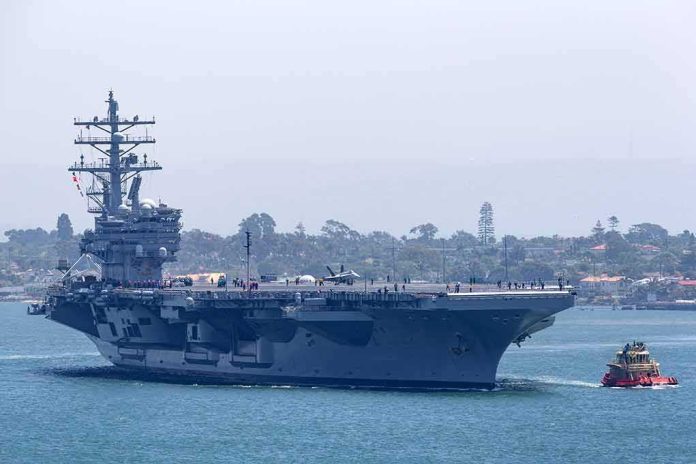
Iran’s top military adviser just warned the fight could jump to the Indian Ocean—putting global trade, energy, and U.S. ships in the crosshairs.
Story Snapshot
- An adviser to Iran’s supreme leader threatened to widen the war to the Indian Ocean if attacked again.
- Iranian security chief Mohsen Rezaei warned U.S. ships would be targeted if fighting resumes.
- Tehran’s messaging fits a long pattern of coercive maritime threats beyond Hormuz.
- Claims and counterclaims around Diego Garcia show how far this fight can reach.
The Warning And What It Means Right Now
Yahya Rahim Safavi, adviser to Iran’s supreme leader, said the front could expand to the Indian Ocean if the United States or Israel attacks again. He tied this to how the conflict already spread from the Persian Gulf and Strait of Hormuz to the Red Sea, and said it could go “perhaps beyond” the Indian Ocean. The statement came via a video circulated by Iranian media and echoed across regional outlets the same day. This is not abstract talk; it is a signal with a price tag.
Mohsen Rezaei, a senior Iranian official, pushed the point further. He warned that if war resumes, U.S. ships in the Indian Ocean “will be attacked wherever they are” unless they leave the region. That claim, carried by Indian media citing an Iranian Embassy post, framed Tehran as ready for a naval clash. It linked Iran’s next move to what Washington does next, which is classic pressure politics meant to shape U.S. choices before shots fire again.
How Credible Is The Threat, And Where Could It Hit?
Iran cannot control a blue-water ocean. It does not need to. Iran has built tools to threaten shipping over distance with drones, cruise missiles, mines, and fast boats launched from its coast or partners’ shores. Defense studies long described an Iranian ability to menace ships past Hormuz into the Gulf of Oman and the Arabian Sea. Analysts warned that growing range, shore-based missiles, and proxy support extend Tehran’s reach into the wider Indian Ocean. That mix makes even a limited strike campaign costly for shippers and insurers.
Energy routes are the pressure point. Tankers leaving Hormuz sail into the Arabian Sea before turning west, south, or east. A harassment campaign does not need daily hits to spike rates and reroute fleets. A few well-placed drone or missile strikes can jam up ports and anchorages, raise premiums, and force escorts. The math is simple: even a small chance of a hit can add big costs to every voyage. That is leverage Tehran knows how to use without matching U.S. firepower ship for ship.
Diego Garcia, Long-Range Shots, And The Risk Ladder
This year brought a sharp dispute over reported missile shots toward the United States-United Kingdom base at Diego Garcia in the Indian Ocean. Iran’s Foreign Ministry denied it and called it a false-flag move, even hinting Israel was behind it. An Israeli general claimed Iran used a long-range ballistic missile with range to European capitals. The episode shows two things: the theater already includes the deep Indian Ocean, and both sides message hard around it.
🚨| Iran Conflict May Be Coming to the Indian Ocean
“Since the conflict has spread from the Persian Gulf and Strait of Hormuz to the Red Sea, it is possible that, in response to more war, the front will expand even further, reaching the Indian Ocean and perhaps beyond.” — Yahya… pic.twitter.com/inkGBdfL7j
— OpGrid India (@OpGridIndia) September 24, 2026
For American conservatives, the lesson is clear. Peace through strength is not a slogan here—it is a shipping invoice. The United States must keep carrier groups, bombers, and patrol craft in position to deter strikes and to kill drones and missiles fast. Rules that tie our hands invite risk at sea. Clear red lines, fast interdiction of arms to proxies, and pressure on financiers reduce Iran’s options. When Tehran raises costs on trade, Washington should raise costs on Tehran’s war machine and its enablers.
What To Watch Next: Triggers, Tactics, And Tells
First, watch for any new U.S. or Israeli strike on Iranian assets. Safavi’s threat is conditional; another round could trigger action in the Arabian Sea lanes within days. Second, watch insurance rates and port advisories; markets move before missiles. Third, watch for messaging about joint patrols. If India, Australia, and the United States tighten escorts, Iran’s window narrows. Fourth, watch for drone debris finds that link back to Iranian models; hard parts beat press releases in telling who did what.
Bottom Line For Shippers, Consumers, And Policy
A widened fight in the Indian Ocean would not look like fleet clashes. It would look like sporadic, deniable hits, a spike in costs, and a slow grind on global supply lines. Iran’s warnings are calibrated to get that effect without inviting total war. The right response is steady patrol strength, tighter sanctions on missile and drone networks, and a loud pledge to keep sea lanes open. Free navigation is not free. But it is cheaper than letting coercion set the toll price.
Sources:
insiderpaper.com, newindianexpress.com, mtv.com.lb, news.az, nampa.org, english.ahram.org.eg, financialports.com