

Bodycam video of a 13-year-old Georgia girl’s motel rescue shows swift police heroics – and also how families now depend on a complex law-enforcement machine because other parts of government keep failing them.
Story Snapshot
- Police bodycam shows officers and a SWAT team rescuing a kidnapped 13-year-old Georgia girl at a Jacksonville motel after an Amber Alert.
- Investigators say the girl’s biological mother, who had no legal custody, took her across state lines and teamed up with a man now facing kidnapping and home invasion charges.
- The rescue involved the Jacksonville Sheriff’s Office, the Federal Bureau of Investigation (FBI), and the Georgia Bureau of Investigation (GBI), underscoring how many agencies must coordinate just to fix one crisis.
- The case highlights a deeper worry shared by many Americans: officials react with force after danger hits, but the system rarely prevents breakdowns in families, courts, and mental health before kids are put at risk.
Dramatic rescue at a Jacksonville motel
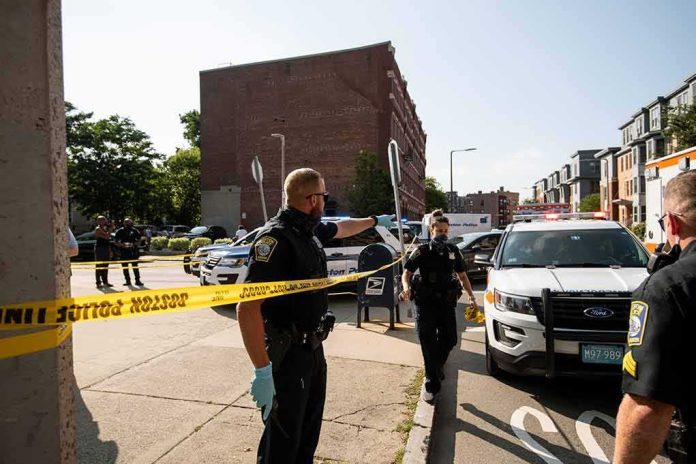
Jacksonville Sheriff’s Office body camera video shows officers and a Special Weapons and Tactics (SWAT) team surrounding the Scottish Inn on Philips Highway on July 16 as they move to rescue a missing 13-year-old girl from Georgia. The girl had been the subject of an Amber Alert and was believed to be in immediate danger. In the video, officers approach the room, weapons drawn, while armored vehicles block escape routes and lights flash in the parking lot. Viewers see a now-familiar scene: loud commands, tense seconds, and then relief when officers confirm the child is alive and safe.
Officials say investigators tracked the girl to the motel after she was taken from her Georgia home by her biological mother, who did not have legal custody. According to the Jacksonville Sheriff’s Office, 42-year-old Jonathon Kelly ran from the room, jumped into a vehicle, and tried to drive away as officers arrived. The vehicle nearly hit a SWAT truck before crashing into the building, where officers were able to take Kelly into custody without the child being harmed. Police also arrested 32-year-old Giovannie Carter, and both now face multiple charges, including kidnapping and home invasion, in a case led by the FBI and GBI.
What the rescue tells us about the system
Jacksonville authorities say the teen is now safe and receiving resources and support after the ordeal. That support likely includes medical care, counseling, and help with the trauma of being taken from home, moved across state lines, and rescued at gunpoint. At the same time, the public record is still thin on key legal details. The news reports do not yet show the custody orders, charging documents, or full probable-cause affidavits that spell out exactly how the mother lost custody and what happened in those crucial hours. That gap matters to many Americans who worry that both courts and child-protection agencies often fail long before police are forced to stage a dramatic rescue.
This case fits a wider pattern in and around Jacksonville, where law enforcement frequently releases bodycam or surveillance footage of child rescues and kidnappings to the public. Other recent stories show officers pulling kidnapped children from wooded areas, hotel rooms, and even cars after crashes. These videos highlight real bravery and fast action. But they also raise a hard question: why does the system keep waiting until children are in extreme danger, instead of fixing the family, mental health, and custody problems that lead to these moments? Many on both the right and the left see this pattern as proof that government acts like a permanent crisis-response machine, not a problem-solving one.
Amber Alerts, multiagency operations, and public trust
The Georgia teen’s rescue was framed as a multiagency success story: local officers, federal agents, and state investigators sharing information and moving quickly once the Amber Alert went out. The Jacksonville Sheriff’s Office praised the joint effort, saying the outcome shows what can happen when agencies work together and treat every second and every life as important. For many viewers, this message is reassuring. It shows that when a child is in danger and cameras are rolling, the government can move decisively and deliver results. But that success also highlights the contrast with slower, less visible systems that Americans interact with every day, like schools, courts, and social services.
Across the political spectrum, people now worry that government only springs into action when sirens are blaring and headlines are at stake. Conservatives frustrated by years of “woke” priorities and bureaucratic waste see these rescues as proof that basic safety should come before grand social experiments. Liberals angry about growing inequality and weak safety nets see the same videos and ask why families do not get real help until disaster strikes. Both sides often agree on one thing: the elites running these systems talk about “coordination” and “resources,” but they rarely fix the root causes that leave kids and parents in chaos.
The power and limits of police video
Bodycam footage has become the main way many Americans see the state in action. In this case, the video gives direct visual proof that a child was found and suspects were arrested. Still, the footage cannot answer every question. It does not show the family court documents, the history of the mother’s relationship with the girl, or whether earlier warnings were ignored. Newsrooms describe the rescue in simple terms—“kidnapped teen found safe after SWAT operation”—but the deeper story of how the family reached this breaking point remains largely off-screen. That missing context feeds public suspicion that the “system” only shares what makes it look good.
For an audience already wary of a distant “deep state,” this case is a double-edged story. On one side, officers did what most Americans want: they risked their own safety to save a child. On the other, the need for such a rescue signals that many parts of government are not doing their jobs before disaster hits. As more of these rescue videos surface, they reinforce a shared fear on the right and the left: that in today’s America, the only time the system really works is when everything has already gone terribly wrong.
Sources:
youtube.com, police1.com, jacksonville.com, fox35orlando.com