
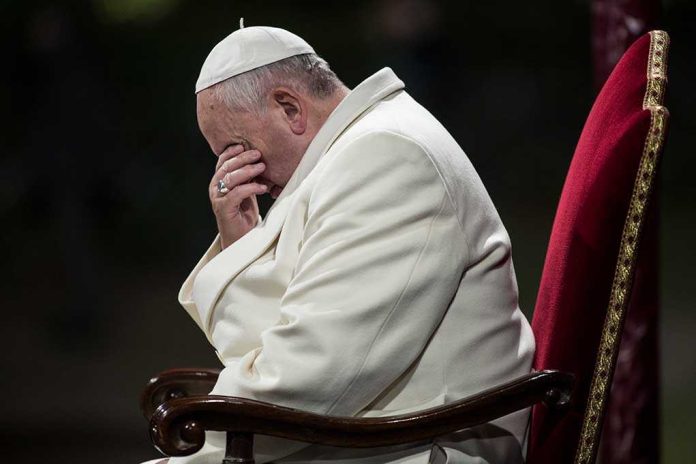
President Trump’s public dismissal of Pope Leo XIV as “weak on crime” and “terrible for foreign policy” marks an unprecedented clash between an American president and the first American pope, threatening to erode critical Catholic voter support as the 2026 midterms approach.
Story Snapshot
- Trump attacked Pope Leo XIV on Truth Social and in public remarks, calling him weak and questioning the conclave that elected him
- Pope Leo, en route to Algeria, responded he has “no fear” of the Trump administration and will continue spreading the Gospel message of peace
- White Catholic approval of Trump dropped from 59% to 52% between January and February 2026, while Hispanic Catholic support fell from 31% to 23%
- The feud erupted during Holy Week over differing views on the U.S.-Israel war in Iran, with Leo calling for laying down weapons while Trump issued crude threats
- Catholic scholars warn Trump’s attacks on the papal conclave process may be perceived as an assault on the faith itself, with no Catholic leaders publicly backing the president
Holy Week Clash Over War Policy
The public confrontation between President Trump and Pope Leo XIV intensified during Holy Week in early April 2026, when the pontiff used his Easter Mass platform to urge combatants in the U.S.-Israel war against Iran to lay down their weapons. Trump responded with vulgar threats against Iran and warnings of civilization’s end, prompting Pope Leo to describe such rhetoric as “truly unacceptable.” The timing of this exchange, occurring during Christianity’s most sacred week, amplified the offense among devout Catholics who saw Trump’s aggressive posture clashing with the Pope’s calls for peace rooted in Gospel teachings.
Trump Questions Papal Election Legitimacy
Following Easter, Trump escalated his criticism by posting on Truth Social that the conclave selecting Pope Leo XIV as the first American pope was politically motivated, suggesting the Catholic Church’s sacred electoral process was compromised. Speaking outside the Oval Office on April 13, Trump doubled down, stating he had “nothing to apologize for” regarding his characterization of Leo as weak on crime and incompetent on foreign policy matters. This unprecedented attack on the papal conclave mechanism struck at the heart of Catholic doctrine, raising concerns among scholars like Andrew Chesnut, chair of Catholic studies at Virginia Commonwealth University, who noted Trump risks being viewed as attacking the religion itself.
Catholic Voter Backlash Threatens GOP Margins
The political fallout from Trump’s confrontation with Pope Leo appears immediate and measurable, with Pew Research data showing white Catholic approval of the president slipping seven percentage points from 59% to 52% between January and February 2026. Hispanic Catholic support experienced an even steeper decline, dropping eight points from 31% to 23% in the same period. These shifts represent a troubling reversal for Trump, who secured a 10-20 point advantage among Catholic voters in the 2024 election, reversing narrow 2020 margins. With Catholics comprising approximately 20% of the U.S. electorate and historically functioning as swing voters unlike more stable religious blocs, continued erosion of this demographic could jeopardize Republican prospects in the 2026 midterm elections.
Religious Leaders Rally Behind American Pope
U.S. Catholic bishops and cardinals have publicly backed Pope Leo XIV in his confrontation with President Trump, condemning the attacks as disrespectful to what Fr. Rocky Hoffman described as “the pastor of the world.” Hoffman, speaking on WGN-TV, emphasized that Trump’s “weak on crime” characterization was particularly offensive given the Pope’s global spiritual leadership role. Chesnut noted that no prominent Catholic leaders have publicly supported Trump’s position, a striking isolation that underscores the depth of concern within American Catholic institutional structures. The unified defense of Pope Leo reflects anxieties that allowing presidential disparagement of the papal office sets a dangerous precedent that could undermine the Church’s moral authority on matters of war and peace.
Pope Leo, maintaining his travel schedule to Algeria despite the controversy, declared on April 13 that he harbors “no fear” of the Trump administration and remains committed to proclaiming the Gospel message loudly. His defiant stance, combined with the absence of any indication either party will back down, suggests this unprecedented clash between the White House and the Vatican will continue to dominate headlines and potentially reshape the relationship between American political power and Catholic moral authority. For voters on both left and right who increasingly question whether Washington elites prioritize political survival over solving real problems, this spectacle of the president attacking the spiritual leader of over a billion Catholics during Holy Week over war policy offers yet another example of governance divorced from the values ordinary citizens still hold dear.
Sources:
Trump vs. Pope Leo threatens Catholic swing voters – Axios