

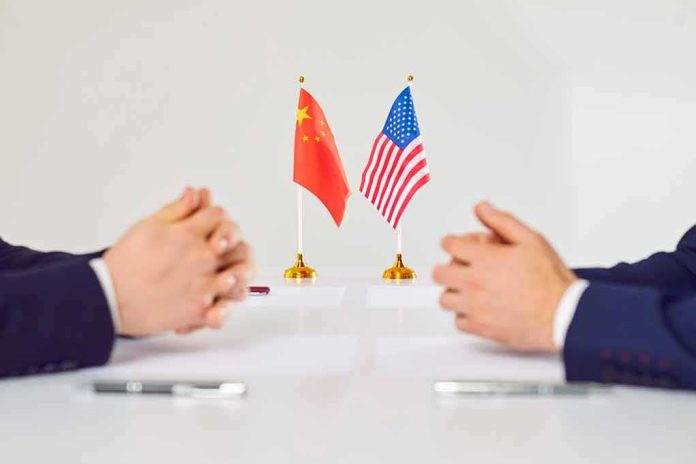
Great-power summits matter most when they reopen channels that had calcified; in Shenzhen, the leaders of the United States, Russia, and China created a direct line at the very top to talk about strategic stability and global security — not a treaty, but the precondition for one.
At a Glance
- President Trump, President Putin, and President Xi held a first joint summit of the three leaders in Shenzhen on November 19, 2026, issuing a heads-of-state declaration on strategic stability and international security.
- The meeting launched a leader-level channel to manage nuclear risk and major-power frictions; it produced commitments to continued dialogue rather than enforceable arms-control terms.
- Beijing framed the theme as safeguarding world peace and stabilizing major-country relations; the U.S. and China also emphasized steadying their bilateral ties.
- Expectations for concrete deliverables were deliberately modest, consistent with summit diplomacy’s pattern of setting principles first and tasking experts later.
What Happened in Shenzhen, and Why It Is Historically Distinct
On November 19, 2026, President Trump met with Russia’s Vladimir Putin and China’s Xi Jinping for a trilateral summit in Shenzhen. The White House published a joint declaration stating that the three leaders met, exchanged views on the international situation, and committed to maintain strategic stability and international security — language that is explicit about intent if not yet operational detail. China’s government, in parallel readouts, described the session as a China–Russia–U.S. summit chaired by Xi, underscoring Beijing’s role as convenor and host. Major international outlets treated the gathering as the first joint summit among these specific leaders — an accurate characterization of its novelty at the head-of-state level.
Form matters in great-power diplomacy. A direct channel among the principals — however carefully scripted — resets the tempo of interaction. It does not, by itself, change force postures or inspection regimes, but it authorizes subordinates to explore those possibilities. Shenzhen achieved that threshold: a top-level commitment to continued dialogue on the most consequential questions in international security.
What the Declaration Says — and Does Not Say
The joint statement’s core is thematic, not technical. It references an “in-depth exchange of views” and a commitment to strategic stability and international security, aligning with the summit’s declared theme of safeguarding world peace and promoting stability in major-country relations. That framing is diplomatic code for the nuclear balance, crisis management, and guardrails on competition — issues that require sustained talks to translate into verifiable measures. Crucially, the document does not specify numerical caps on warheads or delivery systems, verification modalities, or timelines for implementation. Contemporary reporting ahead of the meeting tracked those limited expectations; this was never billed as a treaty-signing session.
On the bilateral flank, the U.S.–China piece emphasized steering relations onto a more constructive track grounded in respect, fairness, and reciprocity — a formulation Beijing highlighted in its readout and that signals both sides’ interest in guardrails after years of turbulence. Such language is consequential as guidance to bureaucracies, even when it stops short of binding commitments; it frames the “left and right limits” for defense, diplomatic, and economic working groups that do the grindwork after the leaders depart.
Mechanism: How Leader-Level Summits Seed Real Agreements
Summitry is often criticized for producing communiqués rather than clauses, but that criticism misunderstands sequence. Technical arms control is an engineering problem married to intrusive verification and doctrine; it cannot be negotiated to a finish line in a single day. The standard pattern is: leaders agree on political principles, define the scope and direction, and authorize experts to translate that guidance into draft text, inspection protocols, and phased timelines. Analysts who previewed Shenzhen were explicit on this point: a one-day meeting cannot decide warhead numbers; it can establish the principles that make real talks possible and direct experts to begin.
That pattern is especially relevant today. The United States and Russia still hold the world’s largest nuclear arsenals, while China’s stockpile and supporting infrastructure are expanding — a structural shift that complicates the bilateral templates of the late Cold War. When three centers of nuclear decision-making are in play, even basic transparency and notification measures become harder to design but more valuable to implement. A political green light from the top is the sine qua non of that work.
Where the Substance Could Emerge Next
If Shenzhen is the starting gun, the race now moves to working groups, deputies’ committees, and defense-policy channels. The immediate candidates for early progress are “no regrets” risk-reduction steps that do not require the full architecture of a formal treaty: crisis-communication modernization; missile and bomber test-launch notifications; rules of the road for bomber and naval operations when platforms operate in proximity; and scoped transparency on new delivery systems. Each offers measurable safety benefits while avoiding premature fights over ceilings and counting rules. The logic here mirrors expert guidance before the summit: begin with principles and low-friction stabilizers, then climb the ladder to more demanding provisions.
In parallel, a trilateral strategic dialogue could draw boundaries around the toughest issues — warhead ceilings, non-strategic nuclear weapons, hypersonic delivery systems, and the integration of missile defense and space-based enablers — and then sequence them into workable packages. None of this is quick. But absent such a channel, misunderstandings metastasize and crisis signaling becomes dangerously binary.
The Role of Beijing’s Framing and the U.S.–China Stabilization Track
Beijing’s public line placed world peace and “major-country” stability at the summit’s center and spotlighted the bilateral objective of steadying U.S.–China relations. In China’s political vocabulary, that combination signals both status and responsibility: China is positioning itself as an indispensable manager of global order while emphasizing reciprocity as a basis for engagement. The State Council readout of Xi’s meeting with President Trump was direct on this point, calling for continued efforts to steer the relationship in the right direction and for a constructive framework built on respect, fairness, and reciprocity. For Washington, those words will be tested against concrete behavior; for the purposes of the Shenzhen channel, they are nonetheless useful as a publicly declared floor for discourse.
Expectations Management: Symbolism, Substance, and the Long Game
Public expectations were intentionally modest. Reporting before and around the summit described a focus on strategic stability and major conflicts, with low odds of headline deliverables — a stance consistent with serious diplomacy rather than stagecraft. The practical standard for judging Shenzhen, therefore, is not whether it birthed a treaty, but whether it catalyzes specific follow-ons: scheduled working sessions, senior-envoy appointments, published agendas, and incremental confidence-building steps. The Council on Foreign Relations’ expert roundups and other analyses echoed this: the value of the first meeting lies in setting direction, not closing accounts the same day.
Trump says nuclear powers need only 'about 10' weapons before Xi, Putin summithttps://t.co/Fvd8Z31XRA
— Yeni Şafak English (@yenisafakEN) November 19, 2026
Why This Channel Matters Even If Wars Continue
Summits do not end wars by themselves, but they can lower the risk that a regional conflict escalates into a great-power confrontation. A direct leader channel allows for rapid deconfliction, private clarification of red lines, and signaling that is less likely to be distorted by intermediaries or domestic politics. History suggests that when nuclear-armed rivals keep talking — consistently, through crises — miscalculation becomes less likely and pathways to restraint open. Shenzhen’s achievement is to restore that possibility at the trilateral level and to put the onus on bureaucracies to prove the leaders’ words can be turned into enforceable guardrails.
Sources:
youtube.com, whitehouse.gov, english.www.gov.cn, cnbc.com, bbc.com, dw.com, belfercenter.org