

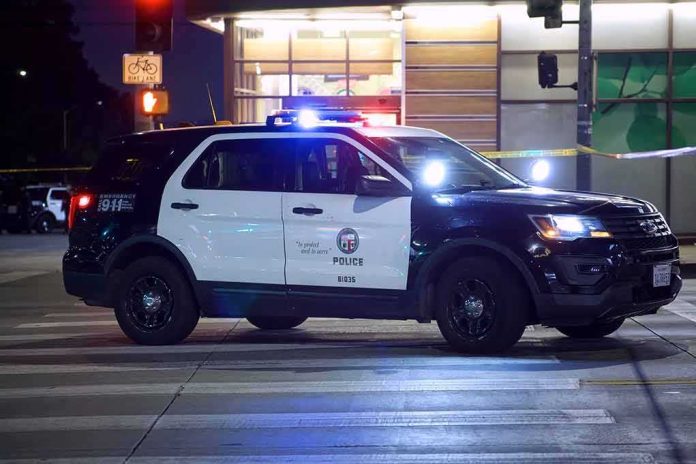
Aerial policing changes the geometry of a pursuit: when an aircraft fixes a suspect’s location and cadence from above, ground units can slow down, coordinate deliberately, and end the incident with fewer gambles on the street.
At a Glance
- Deputies and troopers in Tampa used aviation guidance to follow a suspected stolen box truck and take one person into custody.
- HCSO’s Aviation Unit coordinated ground units from the sky as the truck moved through city streets.
- The pursuit began near I-275 and Fletcher Avenue around 8:30 p.m. and ended near Dr. Martin Luther King Jr. Boulevard and Ridge Avenue.
- Video released by the sheriff’s office shows the surround, window breach, and physical removal of the driver.
What Happened: An Aviation-Led Pursuit Through Tampa
According to contemporaneous local reporting attributed to the Hillsborough County Sheriff’s Office (HCSO), a suspected stolen box truck drew a multi-agency response on a weeknight in Tampa. HCSO said deputies responded at approximately 8:30 p.m. to assist the Florida Highway Patrol near Interstate 275 and Fletcher Avenue. From there, HCSO’s Aviation Unit kept the vehicle under observation and “guided” ground units as the truck threaded through surface streets. The truck later slowed along Dr. Martin Luther King Jr. Boulevard and came to a stop near Ridge Avenue, where deputies executed a containment, broke the driver’s window, opened the door, and pulled the suspect from the cab. One person was taken into custody.
HCSO released video that shows the terminal phase of the stop: multiple deputies establishing a perimeter on the truck, the rapid breach of the driver’s window, and the physical extraction of the driver from the seat to the pavement. While the name of the driver and precise charges were not released in that report, the sequence of actions at the stop—the surround, immediate window access, and removal—aligns with standard tactics for occupied stolen vehicles and barricaded drivers who fail to comply.
Why Aviation Matters in Vehicle Stops
Air support changes both tempo and risk. From a helicopter or fixed-wing platform, a flight crew can maintain continuous eyes-on without pressing a rolling blockade at high speed. That vantage allows ground supervisors to meter resources—positioning units at choke points, timing stop attempts to minimize cross-traffic exposure, and, if policy permits, deploying spike systems in a controlled manner. In dense corridors like I-275 and adjacent arterials, aerial overwatch often substitutes for the high-speed tail that amplifies risk to uninvolved motorists. The strategic aim is simple: convert a kinetic chase into a managed track and end it when and where conditions are safest.
Large commercial vehicles complicate that calculus. A box truck’s mass and elevated ride height limit the effectiveness of precision immobilization techniques and make window access or cab entry more difficult; operators therefore emphasize containment geometry and decisive entry once the vehicle is stationary. The Tampa stop, as depicted, reflects that logic: once the truck halted and relative motion reached zero, the team quickly denied the driver the initiative by breaching glass and controlling the door before a re-engagement could occur.
How We Got Here: Pursuit Policy, Liability, and Practice
American pursuit doctrine has evolved under the twin pressures of public safety outcomes and legal risk. Courts have long recognized that officers owe a duty of care during pursuits while also giving deference to reasonable tactical decisions under dynamic conditions. In Florida, decisions like City of Miami v. Horne and City of Pinellas Park v. Brown outline that balance: officers must drive with due care and are not strictly liable for a fleeing suspect’s independent acts, yet agencies can face exposure when pursuit tactics fall below reasonableness or policy standards. Municipal immunity defenses and federal excessive-force jurisprudence under Graham v. Connor further bracket what is considered objectively reasonable in a stop or extraction, evaluated against the severity of the suspected offense, threat level, and resistance.
Policy reform has followed sobering data. The Police Executive Research Forum, citing federal crash records, reports that more than one person per day died in pursuit-related incidents nationally in 2020 and 2021, underscoring the stakes of when—and how—agencies choose to chase. Roughly a fifth of serious injuries in pursuits fall on third parties, the people policy is designed to protect. Against that backdrop, aviation-assisted tracking is one of the primary risk-reduction tools: by removing the psychological compulsion for a ground unit to cling to a bumper, supervisors can scale down code responses, enforce spacing, and wait for conditions that favor a controlled stop.
Mechanics of the Tampa Stop: Tactics and Sequencing
The timeline reported from Tampa sketches a familiar progression. First, a suspected stolen commercial vehicle is located near a highway interchange—initial risk is high if an immediate interdiction attempt triggers flight on the interstate. Second, a request for air support separates observation from pursuit; a flight crew communicates direction of travel, traffic density, and opportunities for intervention to units staged downstream. Third, as the vehicle transitions to surface streets, supervisors reweigh options: a heavy truck in mixed traffic raises the cost of forced-stop techniques, so the emphasis shifts to containment and time. Finally, once the truck slows and stops, a quick, synchronized entry minimizes the window for renewed flight or assault. The window breach is not punitive; it is a rapid-access method to defeat a closed and potentially locked cab when commands are not followed and keys are inaccessible.
In this case, the arrest location—Dr. Martin Luther King Jr. Boulevard near Ridge Avenue—presents long, straight sightlines and multiple approach vectors, favorable geometry for a surround. The reported sequence—surround, window breach, door open, suspect removed—tracks with training on occupied stolen vehicles and drivers who disregard lawful orders. Those details, and the interagency handoff between Florida Highway Patrol and HCSO with aviation orchestration, are consistent with best practices aimed at reducing pursuit time at speed.
Where Reasonable Disagreement Typically Lives
Two truths often coexist in pursuit cases: apprehending a fleeing suspect can prevent future harm, and a chase itself can create immediate danger. That is why modern policies increasingly calibrate pursuit authorization to the suspected offense, known identity, and real-time risk—some agencies limit chases to violent felonies or when a clear, articulable threat exists. Civil litigation in Florida and the Eleventh Circuit reflects that scrutiny: plaintiffs challenge pursuit decisions or force used at termination; agencies defend with policy compliance, necessity, and the reasonableness of split-second judgments. The Tampa incident, as described, sits on the lower-risk end of that spectrum by virtue of aerial tracking and a stop executed after motion ceased.
Implications: What This Says About Modern Pursuit Strategy
Three operational lessons stand out. First, air-ground integration is not a luxury; it is a control measure that, when available, should be favored over prolonged high-speed following. Second, vehicle class matters—a box truck changes the menu of viable tactics and rewards patience and planning over aggression. Third, decisive but bounded force at the end of a pursuit can compress the most dangerous seconds of an encounter; a clean breach and extraction close options for escalation while keeping the stop brief.
For communities, the significance is practical rather than cinematic. Success is not the number of cruisers in frame; it is the absence of bystander injuries, secondary crashes, or extended highway sprints. As agencies revise policies around pursuits and invest in aviation, GPS tracking aids, and supervisory controls, the aim is to convert more volatile chases into managed recoveries like the one described in Tampa—swift, coordinated, and over before it spills into the next intersection.
A stolen box truck pursuit through Tampa ended with the driver in custody thanks to a team effort from the air and on the ground.
On October 28, 2026, at approximately 8:30 p.m., #teamHCSO’s Aviation Unit responded to Interstate 275 and Fletcher Avenue to assist the Florida… pic.twitter.com/6nGMQz5GOU
— HCSO (@HCSOSheriff) October 29, 2026
What to Watch Next Time You See a Pursuit Clip
When an aerial video of a stop circulates, focus on signals of disciplined control: the presence of air support, the spacing and speed of ground units, whether the stop occurs where traffic is thinnest, and how quickly officers transition from commands to controlled access when compliance fails. Those cues—more than sirens and broken glass—tell you whether an agency treated the encounter as a problem of risk management rather than spectacle.