
Trump’s White House is using executive orders at a pace that keeps putting presidential power back at the center of the fight over how the country is run.
Quick Take
- The White House has an official executive orders page showing many Trump orders in the second term.
- The White House also posted a video titled for a July 13, 2026 signing event.
- Outside trackers from law and policy groups list many Trump executive orders in 2025 and 2026.
- The public record supports that Trump is actively signing orders, but not the exact set signed in the live Oval Office clip.
White House Record Shows Ongoing Use of Executive Power
The White House maintains an official executive orders archive that lists recent Trump orders during the second term. That matters because it shows this was not a one-time stunt or a vague claim. It was part of a steady pattern of presidential action. The administration’s own record, combined with later tracking pages, confirms that Trump kept signing orders across 2025 and 2026.
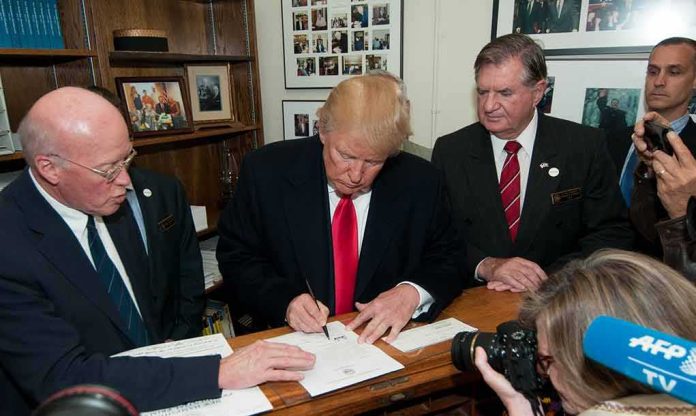
The White House also published a video titled “President Trump Signs an Executive Order, Jul. 13, 2026,” which directly documents a signing event. That is the strongest available proof in the research package that a live White House signing took place. The search results do not, however, identify the exact orders signed in that session or provide a full event transcript.
Independent Trackers Back Up the Broader Pattern
Law and policy trackers also show repeated executive-order use across the second term. Ballotpedia lists 255 executive orders in Trump’s second presidential term, while Akin Gump and the National Association of Foreign Student Advisers both track numerous orders by date and topic. These sources are not the same as a signed order itself, but they do reinforce the larger point that Trump has used executive orders often and publicly.
That larger pattern matters because executive orders are a familiar tool of modern presidents, even when critics call them too unilateral. The public argument around them is often partisan, but the basic fact is not disputed here: Trump has continued to issue orders in office, and the White House has kept an active public archive of those actions.
What the Available Record Does Not Show
The research package does not include the exact Oval Office transcript, the press pool notes, or the signed order PDFs tied to the July 13 event. That leaves a real gap on the number of orders signed, the sequence of signing, and who stood nearby. The record is strong on the fact of signing, but weaker on the details of that specific session.
That gap is important because executive-order events are often staged for maximum message control. Supporters may see them as proof of fast action. Critics may see them as proof of top-down power. Either way, the public usually gets the most polished version first, while the full paper trail comes later through archives and trackers.
Sources:
youtube.com, executiveorderdigest.com, nbcnews.com, hklaw.com, cnn.com, en.wikipedia.org