
As rescue teams dig through rubble, mounting reports suggest Venezuela’s true death toll could dwarf official figures, raising hard questions about transparency and time.
Story Snapshot
- Back-to-back magnitude 7.2 and 7.5 quakes struck northern Venezuela on June 24.
- Officials report hundreds dead and thousands injured; outside models warn fatalities could exceed 1,000.
- Acting leader Delcy Rodríguez declared a state of emergency and shut key transport hubs.
- The United States announced aid and search-and-rescue support under President Trump.
What Happened: Twin Quakes Strike Densely Populated Corridors
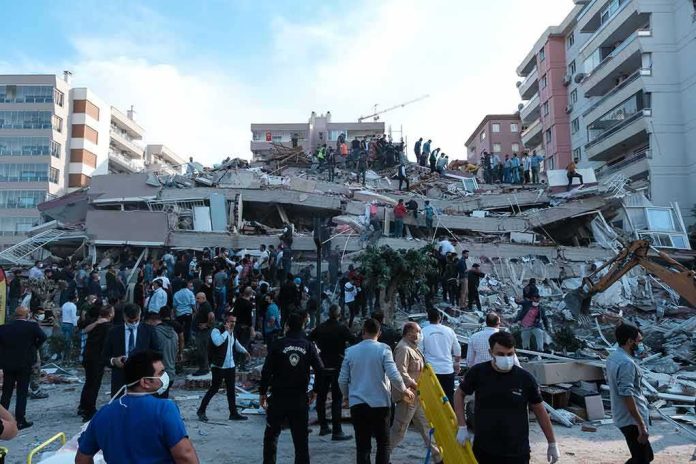
Two major earthquakes hit northern Venezuela minutes before sunset on June 24. The first registered magnitude 7.2. The second, stronger at 7.5, followed less than a minute later. Shaking reached the capital, Caracas, and coastal La Guaira, toppling buildings and cutting power. Government television carried rising casualty numbers as hospitals filled. The Health Minister cited hundreds dead and thousands injured, while aerial images showed widespread collapse and displaced families across several states [1].
Search crews and volunteers raced to free people trapped under concrete and rebar through Thursday and Friday. Local officials described whole blocks in La Guaira as disaster areas. Rescue teams warned that unstable structures slowed entry and increased risk. Emergency groups posted that they were treating the wounded in Caracas and La Guaira. The work grew more urgent as the “golden window” for survivals under rubble began to close, and aftershocks kept nerves on edge [2].
The Numbers Dispute: Official Counts Versus Risk Models
State television reported 200-plus deaths and several thousand injured, with leaders warning totals could rise as crews reach cut-off zones [1]. Independent estimates painted a darker picture. A United States Geological Survey impact model, cited by international outlets, projected a high chance that fatalities would top 1,000 and could reach well beyond that, due to building vulnerability and population density near the epicenters [10]. This split is common in disaster zones, where early official counts lag on-the-ground reality.
Reporters and local leaders noted that some early death totals did not include La Guaira, which officials called the hardest-hit area. That gap fueled doubts and anger among families searching hospitals and temporary morgues. Journalists in Caracas described rescue limits tied to blocked roads, damaged airports, and limited heavy gear. Those barriers make fast, accurate counts hard, but they also raise fair demands for fuller briefings and faster, transparent data sharing as bodies are recovered and identities confirmed [12].
Government Actions and Global Aid: Speed Matters When Lives Hang On Minutes
Acting leader Delcy Rodríguez declared a state of emergency and closed key transport nodes, including the main airport, to clear lanes for relief and inspections [11]. She announced funds to rebuild hospitals and homes and directed finance officials to oversee spending. The United Nations said it was mobilizing assistance. Medical teams and faith-based groups posted updates from triage sites. These steps match standard disaster playbooks, but execution speed will decide how many lives are saved in the first critical days [12].
Death toll crosses 900 in twin Venezuela earthquakes; 172 still trapped after two dayshttps://t.co/PBRa9HfG89
— ThePrintIndia (@ThePrintIndia) June 27, 2026
The United States moved quickly. Under President Donald Trump, the administration pledged support, including search-and-rescue teams, aircraft for damage assessment, and $150 million in aid announced by the State Department, with more coordination through defense channels for lift and logistics [1]. This help matters. American gear, dog teams, and aerial mapping can cut response times and guide where to dig first. Faster mapping and fuel support also help local teams reach isolated neighborhoods before hope fades.
Why This Matters to Us: Truth, Competence, and American Leadership
Disasters test governments. Honest numbers and clear chains of command save lives. When officials lowball casualties or delay updates, families lose trust and waste time. Outside models are not perfect, but they flag risk early so leaders can surge help. That is why transparent reporting and open doors to international teams are vital now in Venezuela. Every hour counts. Families in Caracas and La Guaira deserve the truth, heavy equipment, and steady power to run field hospitals [10].
America’s role is also on the line. Our values prize life, liberty, and the duty to help neighbors in crisis. Smart aid advances all three. It uses strong borders at home and strong leadership abroad. It cuts red tape, moves planes and generators, and puts trained hands on rubble. This is not globalism. This is targeted, accountable help that shows what free people can do. The Trump administration’s swift offer of assets and funds reflects that mission and should continue until Venezuelan communities stand back up [1].
What To Watch Next: The Toll, Access, and Power Restoration
Watch for revised death counts as rescuers reach La Guaira and other hard-hit areas. Track airport and port status, fuel flows, and how fast heavy gear gets to collapsed structures. Follow hospital capacity, blood supplies, and field clinic setups in Caracas. Look for regular, public briefings that reconcile official numbers with risk models and local reports. Demand full access for independent teams. These steps will signal whether lives are being saved at the pace this disaster demands [11].
Sources:
[1] Web – Venezuela earthquakes kill nearly 1,000, tens of thousands missing
[2] Web – Venezuela rocked by 7.5 and 7.2 magnitude earthquakes – CNN
[10] Web – UN_Spokesperson on the earthquakes in #Venezuela – Instagram
[11] Web – Early data on the devastating twin earthquakes in Venezuela
[12] Web – Rescuers race to find Venezuela quake survivors – BBC