

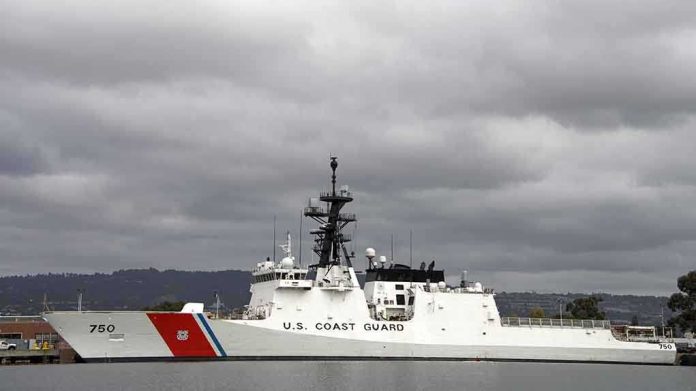
A stealthy go-fast boat packed with cocaine and marijuana sprinted from Venezuela toward the Caribbean—until American cutters, sailors, and aircrews stopped it cold.
Story Highlights
- Coast Guard offloads a multimillion-dollar haul after Caribbean interdictions, including cocaine and marijuana [8].
- Navy-supported pursuit matched classic smuggler tactics: no transponder, no radio, high speed, heavy load [6].
- Record 2025 seizures show a hard turn against cartels and their sea routes into our hemisphere [4].
- Media critics fixate on “militarization,” but crews found real drugs on real boats near Venezuela [3].
What Was Seized And Why It Matters
Coast Guard crews offloaded more than $141 million in drugs from recent Caribbean operations, confirming a strong run of seizures that kept thousands of pounds of cocaine and marijuana off U.S. streets [8]. The operation adds to a record year in 2025, when the service reported more than 511,000 pounds of narcotics seized, valued at about $3.8 billion [4]. These results reflect focused patrols, better maritime tracking, and teamwork with Navy ships and allied partners in waters used by smugglers.
The haul’s scale lines up with ongoing interdictions near Venezuela, where Coast Guard personnel and allied crews have stopped fast boats and recovered large bundles of cocaine. A posted Coast Guard photo log shows an interdiction northeast of Venezuela last June with more than 1,100 pounds seized, underscoring how that corridor remains active for cartels even if it is not the main path into the United States [13]. Each seizure disrupts cartel finances, denies street supply, and protects American families from violent drug networks.
How The Smuggling Tactics Gave Them Away
Navy and Coast Guard teams watched a small, under-40-foot boat move at more than 20 knots with a heavy load, no automatic identification transponder, and no response to radio calls—classic smuggler signs reported by maritime law enforcement for years [6]. A boarding team later found multiple triple-sealed bundles of cocaine in the hold, matching standard smuggling methods for long runs over open water [6]. The crew lacked fishing gear, life jackets, or personal items, which also supported probable cause for a full search [6].
These facts matter because some voices claim the United States is “militarizing” the Caribbean. But when officers recover marked bricks and bales, the debate shifts from theory to evidence. Senior Coast Guard and Drug Enforcement Administration leaders have stated they will use every legal tool to stop drug boats that endanger Americans and fuel transnational crime [3]. In practice, that means cutters, helicopters, small boats, and sometimes Navy support working together to end dangerous chases at sea.
Where Venezuela Fits—Transit Hub, Not Producer
Coast Guard leaders have highlighted many vessels tied to Venezuela during major offloads, including the service’s largest on record in 2025, which featured cocaine from multiple boats linked to that country’s waters [1]. That aligns with field patterns that show Venezuela used as a staging or transit area for Colombian cocaine headed into the Caribbean. It does not make Venezuela the main source for U.S.-bound cocaine, but it does make the corridor a real threat vector that law enforcement cannot ignore.
Broader drug intelligence often shows Venezuela is a transit zone, not a producer, and that most U.S. supply flows through other routes. Yet the practical takeaway for our homeland is simple: when go-fast boats run dark and heavy near that coastline, Coast Guard and partners need freedom to interdict them. Interdictions there protect Americans, and they reinforce the rule of law against cartels that exploit weak regimes and corrupt ports.
Balancing Aggressive Enforcement With Accountability
Critics argue that tougher posture at sea risks mistakes. Coast Guard data from past years show most interdicted boats do carry contraband, though not all do. That is why process, warrants, and clear rules of engagement matter. Recent operations have featured warranted boardings in complex cases, including maritime seizures tied to sanctioned cargo that funds terrorism, showing that law enforcement and judicial oversight can work at sea even in tense waters [3].
💥💥💥‼️‼️‼️US Coast Guard has seized over 225,000 pounds of cocaine in eastern Pacific https://t.co/EsbQkG3QRI
— CHRISTIAN CONSERVATIVE FIGHTERS FOR FREEDOM !!! (@timlatimer365) June 21, 2026
For conservative readers, the stakes are clear. Families suffer from drugs that fuel crime, destroy towns, and burden taxpayers. The administration must keep pressure on cartels, back the Coast Guard with resources, and demand transparency that proves operations are lawful and effective. The record seizures, the documented bales, and the coordination with Navy assets tell a firm story: when America projects law at sea, cartels lose. That is how you defend communities and uphold our Constitution—without apology.
Sources:
[1] Web – Coast Guard’s $63M Drug Haul Includes 7,700 Pounds of Cocaine, 4K …
[3] Web – U.S. Forces Seize Sixth Oil Tanker Linked to Venezuela
[4] YouTube – U.S. Coast Guard led seizure of oil tanker near Venezuela with Navy …
[6] Web – Trump says US still actively pursuing oil tanker linked to Venezuela …
[8] Web – EXCLUSIVE: Never-before-seen photos following the U.S. seizure of …
[13] YouTube – US Coast Guard announces major illegal drug seizure including 61,700 …