

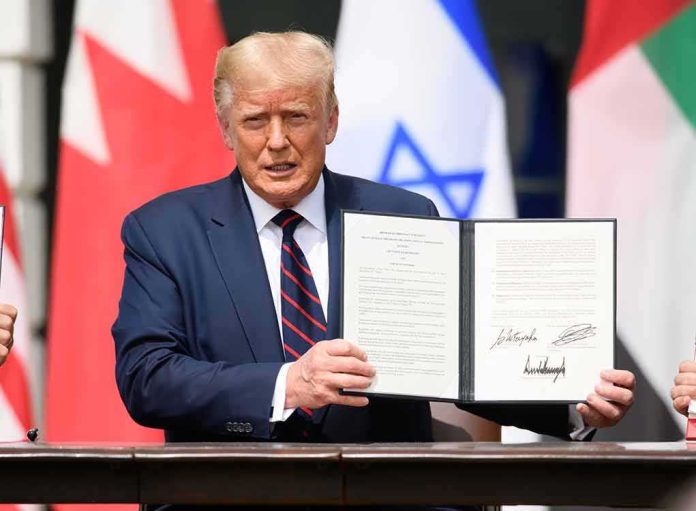
As details of President Trump’s Iran memorandum finally see daylight, even Fox & Friends is asking whether Washington gave up leverage without locking in America’s core security goals.
Story Snapshot
- Fox & Friends hosts, usually friendly to Trump, now question whether the Iran ceasefire meets U.S. objectives.
- The 14‑point memorandum promises a broad ceasefire and sanctions relief while leaving nuclear and missile limits mostly to future talks.
- Conservatives worry Tehran gets time, cash, and open sea lanes while still enriching uranium and backing terror groups.
- The deal’s 60‑day “window” and missing enforcement tools raise hard questions about verification and U.S. strength.
Fox & Friends raises doubts about unmet war goals
On Fox & Friends, co-host Lawrence Jones walked through the Trump administration’s original war goals one by one and admitted that “we have not reached any of those objectives.”[5] He listed the aims viewers heard for months: dismantling Iran’s nuclear facilities, ending uranium enrichment, shipping enriched uranium out of the country, allowing full international inspections, and suspending Iran’s ballistic missile program.[5] Then he bluntly said none of that has happened so far. That kind of candor from a show usually seen as pro-Trump caught many conservatives off guard and underscored how unfinished this agreement really is.
Other coverage echoed that unease. A Ground News summary of the Fox segment notes that Iran is still enriching uranium and has not halted its missile program, even after the ceasefire announcement.[6] Another outlet described Fox’s treatment of the arrangement as calling it a “complete Trump failure,” saying the ceasefire “accomplishes none of the administration’s goals.”[7] For many right-leaning viewers, hearing Trump’s own favorite channel say his stated red lines are not yet met sends a clear signal: This is, at best, a work in progress, not a mission-accomplished moment.
What the memorandum actually promises Iran and the U.S.
The 14‑paragraph memorandum of understanding sets out a broad ceasefire “on all fronts,” including Lebanon, and calls for ending active hostilities between the United States, Iran, and their proxies.[1] It states that Iran “reaffirms that it shall not procure or develop nuclear weapons,” echoing language from past nuclear talks but without new on-the-ground monitoring tools attached.[1] The document commits the United States to terminate “all types of sanctions” against Iran, even mentioning United Nations measures, but ties actual relief to implementation and “good faith” behavior over time rather than a fixed date.[3]
On the economic and energy side, the memorandum orders the immediate reopening of the Strait of Hormuz, with commercial ships allowed toll‑free passage for sixty days.[1] After that, Iran and Oman are supposed to negotiate how the vital waterway will be managed long term, leaving future costs and control undecided.[5] The text also sketches a framework for a reconstruction plan of “at least $300 billion” for rebuilding Iran, to be put together by regional partners with no legal requirement that U.S. taxpayers foot the bill.[3] Supporters frame this as a way to shift costs to Gulf allies, while skeptics hear a giant pot of money where politically connected firms could cash in.
Nuclear “status quo” and missing enforcement fuel conservative backlash
One of the biggest sticking points for skeptics is what the deal does not yet do. The memorandum keeps Iran’s nuclear program in a “status quo” posture until negotiators work out what to do with Iran’s enriched uranium and future enrichment, meaning there is no immediate dismantling of centrifuges or shipment of fuel out of the country.[1] Reports note that the text only says the sides will “discuss the issue over enrichment,” instead of ordering Iran to surrender its current stockpile for destruction.[4] Critics say that gives Tehran room to stall while sanctions pressure eases and regional tensions cool.
Fox News’ own special coverage underlined that gap. During a breakdown of the framework, one analyst noted that the plan does not create new weapons inspection regimes or automatic sanctions “snapbacks” inside the text itself.[1] Instead, enforcement is left to President Trump’s threat that if Iran “colors outside the lines,” he will respond with military force.[1] Many conservatives like a tough posture, but they also remember how Iran used vague language in past deals to push limits and hide activity. Without clear inspection rights and triggers, a promise on paper that Iran will not seek nuclear weapons can be very hard to test.
Ceasefire, allies, and the risk of rewarding bad behavior
The ceasefire also reaches into Lebanon, but the memorandum specifically says neither Lebanon nor the Hezbollah militia are formal parties to the agreement.[2] That creates a serious enforcement problem. Israel’s government has already signaled it will keep striking Hezbollah targets in Lebanon and insists “the struggle has not ended,” putting facts on the ground at odds with the ceasefire language.[1] Iranian officials, for their part, claim that continued Israeli action violates the deal and have floated plans to charge fees in the Strait of Hormuz in the future.[1] These clashing messages make many viewers wonder how durable any paper ceasefire can be.
Trump Blasts Iran Deal Critics And Touts Market Reaction—U.S. Gas Prices Fall Below $4 https://t.co/1abXc86bTZ
— The Right News, Right Now. (@BradPorcellato) June 18, 2026
Right-leaning media watchdogs describe an open revolt in parts of the conservative press over the memorandum.[8] Some commentators call it “appeasement” and “capitulation,” arguing that Iran used its control over Hormuz as leverage to win relief while giving up little on terror support or missiles.[8] Republican lawmakers such as John Thune, John Kennedy, Bill Cassidy, and Roger Wicker have voiced skepticism and pressed for Senate review, warning that a major shift on sanctions and nuclear policy should not move forward on a vague sixty‑day framework alone.[11] The political risk is clear: if Iran drags out talks or cheats, critics will say Washington traded away pressure for promises the regime never meant to keep.
Sources:
[1] Web – Fox & Friends Hosts Skeptical of Trump’s Iran Deal: ‘Why Would They Do …
[2] YouTube – US releases details of the MoU with Iran
[3] YouTube – US-Iran ceasefire terms released after deal officially signed
[4] Web – What’s in the US-Iran agreement?
[5] Web – What’s in the Iran deal Trump says he’s ready to sign
[6] Web – Trump and Iran’s president sign initial deal to end war …
[7] Web – Trump signs Iran MOU at Versailles
[8] YouTube – Trump signs US-Iran MoU in Versailles after G7 summit
[11] Web – 🚨 President Donald J. Trump has SIGNED the Iran …