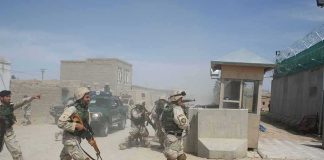

Viral chatter about “boots on the ground” is colliding with a real deployment of 2,500 Marines—forcing Americans to separate social-media panic from what the Pentagon is actually signaling in the Middle East.
Story Snapshot
- The Pentagon ordered roughly 2,500 Marines from the Japan-based 31st Marine Expeditionary Unit and the amphibious assault ship USS Tripoli toward the Middle East.
- Officials stressed the movement is meant to give commanders flexible response options, not announce an imminent ground invasion of Iran.
- Iran-linked pressure on commercial shipping in the Strait of Hormuz is a central driver, putting a major global energy chokepoint at risk.
- Reporting differs on troop totals because some outlets count only the MEU while others include the broader amphibious ready group with additional sailors and support elements.
Pentagon orders 31st MEU and USS Tripoli toward the region
Defense Secretary Pete Hegseth approved a CENTCOM request to send roughly 2,500 Marines from the 31st Marine Expeditionary Unit, along with the amphibious assault ship USS Tripoli, from Japan toward the Middle East. The deployment was reported March 13, 2026, and officials said the force was still more than a week from waters near Iran. That timing matters because it undercuts claims that U.S. forces are already positioned for immediate offensive action.
The 31st MEU is not just an infantry package; it is built for fast crisis response across a wide mission set. Reporting on the deployment highlighted aviation assets associated with the unit, including F-35 Lightning II aircraft and MV-22 Osprey tiltrotors, which can rapidly move troops, deliver air support, and extend reach without a large permanent footprint. That versatility is why MEUs are routinely used for deterrence, evacuation, and embassy reinforcement when a region destabilizes quickly.
Why the Strait of Hormuz keeps pulling America back in
Iran’s pressure campaign against shipping has elevated the stakes because the Strait of Hormuz is one of the world’s most important energy transit routes. When shipping faces attacks or credible threats, the risk isn’t abstract: it can raise insurance costs, disrupt schedules, and tighten global supply expectations. For U.S. families already tired of years of inflation and fiscal mismanagement at home, instability at a key oil chokepoint is exactly the kind of external shock that can ripple into higher prices.
U.S. policy objectives, as reflected in the reporting, center on protecting shipping lanes, reassuring partners, and deterring further escalation without automatically committing to a full-scale war. That approach aligns with a limited-government, limited-war mindset many conservatives prefer: clear interests, defined missions, and avoiding open-ended nation-building. At the same time, a visible forward deployment signals that Washington is not outsourcing maritime security to global institutions that often talk big and deliver little when the shooting starts.
Separating invasion rumors from documented mission capability
Online speculation surged with claims that the Marine movement proves a ground invasion of Iran is imminent. The reporting cited officials pushing back, emphasizing that an MEU gives commanders “options” and does not itself confirm an invasion plan. In practical terms, an amphibious force can be used to protect U.S. facilities, extract civilians, reinforce an embassy, or provide a quick-response reserve if other forces come under threat—missions that do not require a politically explosive decision to invade.
Americans should also read the troop-number debate carefully. Some reports describe roughly 2,500 Marines, while others reference totals closer to 5,000 when sailors and additional amphibious ready group elements are included. That discrepancy is common in military coverage and doesn’t prove deception; it usually reflects different counting rules. What can be concluded from the reporting is narrower: a significant force package is moving, it has air and sea capability, and it is intended to expand response capacity.
Regional war dynamics raise the cost of mistakes
The deployment lands in a region already strained by Israeli strikes, Iranian retaliation, and Hezbollah’s renewed operations after a prior ceasefire reportedly broke down. Reporting described heavy casualties in the wider conflict environment and highlighted U.S. losses as well, including deaths tied to a KC-135 crash in Iraq. Those facts are a reminder that even “measured” moves occur in a lethal environment, where accidents, miscalculation, or a single successful attack can rapidly expand the mission.
BREAKING: 2,500 Deployed Marines Heading to the Middle Easthttps://t.co/oikjQwrptQ
— PJ Media (@PJMedia_com) March 13, 2026
Diplomatic messaging has not disappeared, with reporting noting Iranian outreach to Egyptian leadership about de-escalation even as military activity continues. For the Trump administration, the practical test is whether deterrence can be restored without sliding into an indefinite conflict—especially after years when Americans watched overseas priorities pile up while the southern border and domestic stability were neglected. Based on the available reporting, the deployment is best understood as a readiness and protection move, with invasion claims unproven.
Sources:
Fact check: US Marines to launch ground invasion in Iran? Here’s what USS Tripoli deployment means
US deploying roughly 2,500 Marines to Middle East
6 U.S. airmen die in crash; Hegseth says Iran’s leader is likely disfigured
US orders 2,500 Marines and an amphibious assault ship to Mideast after almost 2 weeks of war