
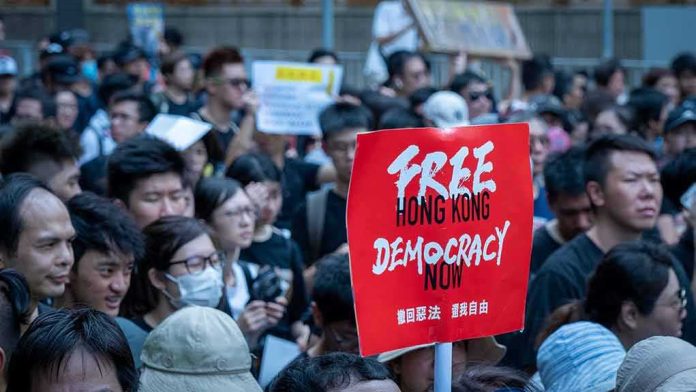
Hong Kong judges convicted two former Tiananmen vigil organizers of “inciting subversion,” signaling how remembrance itself now risks prison under Beijing’s security rules.
Story Highlights
- Hong Kong court found Lee Cheuk-yan and Chow Hang-tung guilty of inciting subversion
- Case centers on a disbanded group that ran annual Tiananmen candlelight vigils
- Defense framed actions as lawful commemoration and free speech, not subversion
- Ruling fits a wider clampdown on civic space since the 2020 security law
The Verdict and What It Means
Hong Kong’s Court of First Instance convicted Lee Cheuk-yan and Chow Hang-tung of “incitement to subversion,” a charge that can carry up to 10 years in prison. The court ruled their leadership of the Hong Kong Alliance, which organized Tiananmen vigils, encouraged others to oppose China’s one-party rule. Judges had earlier held there was a case to answer based on the prosecution’s evidence, clearing the way to this outcome. Media reported the guilty verdicts as a landmark under the security regime.
Prosecutors argued the Alliance’s long-standing calls to “end one-party dictatorship” showed intent to challenge state power. They tied slogans, events, and group charters to a plan to undermine the Chinese Communist Party. The government’s case leaned on the National Security Law, passed in 2020, which broadened the definition of subversion and raised penalties. This legal shift means speech and assembly can be recast as threats when linked to political change goals.
The Defense and Free Speech Claims
Chow Hang-tung, a barrister, pleaded not guilty and said her aim was remembrance, not revolt. She told the court she sought to “incite others not to forget June 4,” arguing that honoring victims is not a crime. Her closing statement said the case flipped right and wrong by defining truth-telling as hate and civic duty as subversion. Rights groups called the trial punishment for peaceful commemoration and urged immediate release of both defendants.
Chow also advanced a narrow reading of “subversion,” saying it should mean using outside forces to rapidly and abnormally upend the order, which she said did not happen here. That view clashed with the prosecution’s theory that advocacy itself, tied to organizational aims, can cross into incitement. The judges’ final reasoning, which followed their earlier finding of a case to answer, adopted the broader state security lens rather than Chow’s proposed limit.
Why This Case Resonates Far Beyond Hong Kong
The ruling reflects a wider pattern since 2020: authorities treating civic groups, slogans, and memorials as national security risks. Researchers at Georgetown’s Center for Asian Law describe the security law as a major threat to rights and the rule of law, with arrests and group closures reshaping civil society. They detail how speech, assembly, and association face criminal exposure under overlapping security and sedition rules. This trend chills activity well beyond street protests.
Hong Kong Tiananmen Vigil Organisers Guilty Verdicts Expose A Show Trial System of Justice. Chow Hang-tung prison letter to @andyburnham
See Report by @dannydvincent in the Guardian.
Tiananmen Square vigil organisers
Lee Cheuk-yan and Chow Hang-tung – leaders of the Hong Kong…— Lord (David) Alton (@DavidAltonHL) August 21, 2026
For Americans watching from across the Pacific, the stakes are clear. When governments can brand remembrance as revolt, everyday people lose space to speak, gather, and question power. Many on the right and left fear elites rewrite rules to protect themselves and silence critics. This case shows how process can become punishment. It is a warning about how quickly legal tools grow, how quietly lines move, and how hard it is to win those freedoms back once lost.
Sources:
independent.co.uk, abcnews.com, amnesty.org, frontlinedefenders.org, bbc.com, today.rtl.lu, srdefenders.org