

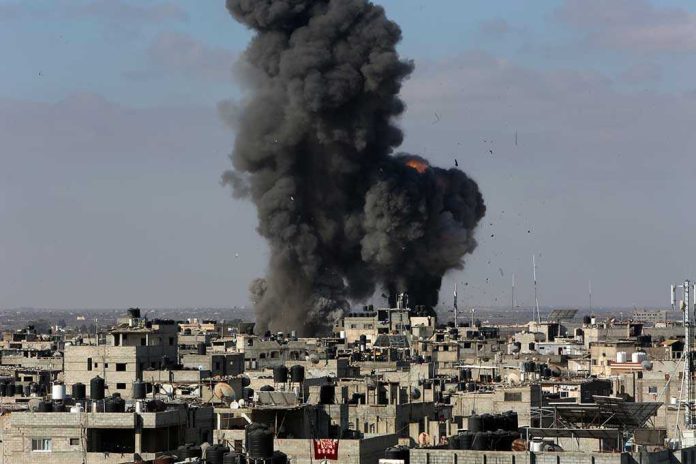
Six American service members are dead in Kuwait after Iran’s retaliation—an escalation that’s now exposing both the cost of confronting Tehran and the dangerous friction of coalition warfare.
Story Snapshot
- CENTCOM-confirmed U.S. deaths rose from early reports to six after remains of two previously unaccounted-for service members were recovered from a struck facility in Kuwait.
- Iran’s regional retaliation followed U.S.-Israeli strikes that began Saturday under Operation Epic Fury, widening the conflict across multiple Gulf countries.
- Three U.S. fighter jets were unintentionally downed by Kuwaiti air defenses during the operation, underscoring coordination risks even among partners.
- President Trump and senior defense leaders framed the campaign as focused on stopping Iran’s missile capability and preventing a nuclear weapons outcome.
Six U.S. deaths confirmed as recovery operations continue in Kuwait
U.S. Central Command confirmed six American service members have been killed following Iranian retaliatory attacks connected to the opening phase of Operation Epic Fury. The fatality count climbed after U.S. forces recovered the remains of two service members who had been unaccounted for at a facility hit during Iran’s initial strikes. Reporting indicates all six deaths occurred in Kuwait and were tied to the same wave of Iranian retaliation over the weekend.
Iran’s retaliation has been described as geographically broad, with ballistic missiles and drones launched toward U.S. military and commercial interests across several Gulf nations. While many incoming weapons were intercepted, reporting indicates some penetrated defenses and caused damage, including in civilian areas. For American families, the result is not abstract: the military shifted from early casualty reports to a higher confirmed toll as the situation on the ground became clearer.
Operation Epic Fury widens the battlefield and strains regional defenses
U.S.-Israeli strikes against Iran began Saturday, and Iran responded with sustained missile-and-drone pressure across the region, pulling multiple host nations into the operational picture. The operation’s stated objectives, as described by senior U.S. leaders, include degrading Iran’s missile production and naval infrastructure while preventing a nuclear weapons trajectory. Gen. Dan Caine also announced additional U.S. troop deployments to the Middle East as combat operations continued.
Those operational demands come with real-world complexity: coalition basing, overlapping radars, multiple rulesets, and split-second air-defense decisions. When many allied systems operate inside crowded airspace, the risk of misidentification rises even when the overall mission is clear. That reality matters for U.S. readiness because it affects how safely American aircraft can operate near partner defenses and how confidently commanders can execute time-sensitive missions.
Friendly fire incident: three U.S. jets downed by Kuwaiti air defense
Axios reported that three U.S. fighter jets were unintentionally shot down by Kuwaiti air defense systems at 11:03 p.m. ET Sunday during Operation Epic Fury. All six aircrew members ejected safely and were reported in stable condition. Kuwait confirmed the incident and an investigation is underway, placing a spotlight on air-defense integration, identification protocols, and how quickly coalition partners can adapt during an escalating fight.
The friendly-fire episode is distinct from the confirmed fatalities, but it sharpens the same lesson: modern war isn’t only about enemy capabilities—it’s also about whether allied systems can work together under stress. The available reporting does not provide a detailed technical cause, such as IFF failure or command-and-control confusion, so conclusions should be limited to what’s known: an acknowledged misfire, safe ejections, and a pending investigation.
Trump administration frames objectives around deterrence and preventing escalation
President Trump described the conflict as a “last best chance” to address Iran’s ballistic-missile threat and prevent an Iranian nuclear weapons outcome, while signaling the campaign could last weeks and that ground troops remain a possible option if necessary. Secretary Pete Hegseth emphasized a “laser-focused” approach aimed at missile production and naval infrastructure, rejecting comparisons to open-ended wars and stressing defined objectives.
US casualties rise to 6 following Iranian retaliation for massive strikes https://t.co/PsxTzozbLt
— ConservativeLibrarian (@ConserLibrarian) March 2, 2026
For Americans wary of endless foreign entanglements, the key question is whether those objectives can be met without mission creep, while still protecting U.S. forces and U.S. interests like maritime security. The research also notes uncertainty around casualty reporting on the Iranian side, including competing figures and limited confirmation. What is certain, based on official U.S. updates and major outlets’ reporting, is the confirmed American loss of life and an operational environment growing more complex by the day.
Sources:
3 U.S. fighter jets downed by friendly fire in Kuwait
US casualties rise to 6 following Iranian retaliation for massive strikes
Iran-U.S. war live updates: Day 3, American deaths, Israel, Gulf allies hit in missile strikes
2026 Iran–United States crisis