
When violence erupts at the edge of a major public gathering, the event becomes the headline — but proximity is not causality; what is established here is painfully simple: nine people were shot near Birmingham’s Legion Field after the Magic City Classic, one died, and police launched a large-scale response focused on victims, evidence, and public safety.
The Short Version
- Nine shot near Legion Field after the Magic City Classic; one victim died, eight were injured.
- Police responded around 7:50 p.m. to the 400 block of Graymont Avenue West, near vendor and tailgating areas.
- Multiple firearms were recovered; one individual was detained for questioning.
- Tailgating was suspended and the public asked to avoid the area while investigators sought witness video.
What Happened: The Confirmed Sequence
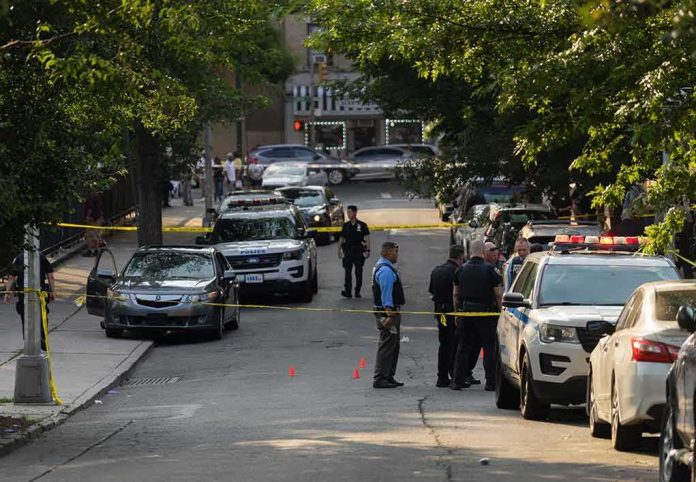
Shortly after 7:50 p.m., Birmingham police and fire-rescue units converged on the 400 block of Graymont Avenue West — the corridor bordering Legion Field long used for postgame vendor activity and tailgating — after reports of gunfire and multiple victims. Officers found nine people with gunshot wounds; one person was later pronounced dead, while eight others were transported or treated with injuries that, according to officials, ranged from critical to non-life-threatening. The basic facts of time, place, and casualty count come directly from police accounts echoed by major outlets that were in contact with department spokespeople on the night of the incident and into the following day.
Within hours, the department reported seizing multiple firearms from the scene. A spokesperson stated that one person was detained and taken to headquarters for questioning; as of those initial updates, police had not described that person as a suspect or identified any charges. In parallel, command staff issued a public safety posture consistent with an active, complex scene: tailgating was suspended, the public was told to avoid the stadium area, and detectives asked witnesses to submit any video that could clarify who fired, from where, and when.
Where It Occurred: Near, Not Inside, the Stadium
The geography matters. Reporting centered the shooting on Graymont Avenue West, adjacent to Legion Field, in areas where vendors and tailgaters remained after the Alabama A&M–Alabama State game. Some headlines compress that to “at Legion Field,” but the more precise description is “near Legion Field after the game.” That framing reflects what investigators could verify at the time and respects a distinction with consequences for venue operations, liability, and reputation: the incident unfolded outside stadium property, in the surrounding public right-of-way where crowds still clustered after the final whistle.
This proximity pattern is not unique to Birmingham or to the Magic City Classic; public safety professionals plan for the long tail of crowd dispersal because the kinetic risk profile of a major event does not end at the exit gates. Local archives document prior, separate shootings near the Classic over the years — not proof of a causal chain, but a reminder that the area’s density, lighting, and egress routes during marquee weekends can create conditions where private disputes or opportunistic violence have outsize consequences.
What Police Did on Scene and Why It’s Standard Practice
Large-scene firearms investigations begin with triage and containment, then pivot to evidence control and timeline reconstruction. The reported recovery of multiple firearms is consistent with a scene where more than one person was armed — not, by itself, proof that each weapon was discharged or involved. In practice, technicians photograph, swab, and log each weapon into the property room, then match make, model, and serial number with shell casing inventories and any available ballistic signatures. That process usually runs through a state crime lab and the National Integrated Ballistic Information Network (NIBIN) to identify prior links to casings from other scenes. None of that lab work is instantaneous on the night of a shooting; what was shared publicly was the immediate, operational fact that guns were secured for analysis.
Detaining an individual for questioning similarly fits the script of early-scene triage. On nights like this, investigators identify and separate people closest to gunfire — whether because they were wounded, carried a firearm, ran from a particular direction, or appeared in early witness accounts — and then sort participants from bystanders as video and statements accumulate. The public record at this stage describes detention and questioning, not an arrest or charge, and does not attribute a name or alleged role to the individual; that is the limit of what’s supported by the initial disclosures.
Victims and Medical Status: What Was Publicly Reported
The casualty profile stabilized quickly around nine shot: one deceased, one in critical condition, and seven in stable or non-life-threatening condition. That breakdown, shared by police through multiple outlets, provides more signal than an undifferentiated total; it helps hospitals, families, and city leaders calibrate response and understand resource strain across trauma centers. These are the numbers investigators and public information officers were willing to stand behind in the immediate aftermath, and they anchor the event’s factual core.
Authorities had not released identities for the deceased or injured at that point — standard both for next-of-kin notification and because witness intimidation and evidence protection concerns are heightened in gun cases with multiple potential shooters. As a result, early public updates focus on counts and conditions rather than names and narratives.
One person was killed and eight others were wounded in a mass shooting just outside Legion Field after the annual ‘Magic City Classic’ football game on Saturday night, police in Birmingham said. https://t.co/St0E5AX8x9
— South Florida Sun Sentinel (@SunSentinel) November 2, 2026
Context: The Classic’s Scale and the Public-Space Challenge
The Magic City Classic is one of the largest annual HBCU gatherings in the country, with tens of thousands attending the game and many more circulating in the vendor and tailgate footprint before and after. That scale generates a security paradox: concentrated law enforcement resources inside and immediately around the venue, and rapidly changing risk in the surrounding blocks as crowds ebb, traffic locks intersections, and visibility drops. The city’s decision to suspend tailgating and clear adjacent areas reflects that real-time assessment; with open questions about how many shooters were involved and no immediate motive publicly identified, priority shifts to creating clean lanes for EMS, preserving evidence, and minimizing secondary harm.
What Is Firmly Established — And What Was Not Claimed
On the facts supported by on-record police statements and consistent contemporaneous reporting, the through-line is clear: nine shot, one dead; response launched near 7:50 p.m. on Graymont Avenue West; multiple firearms recovered; one person detained for questioning; tailgating suspended while investigators sought video. Those details hold across outlets in contact with Birmingham Police and reflect the department’s official posture during an active investigation.
Importantly, those same statements do not assert an identified shooter, a motive, or a confirmed link between each recovered firearm and fired rounds. They also do not place the gunfire inside the stadium. Staying within those boundaries is not hedging; it is accuracy — and it is how an early, disciplined account remains reliable as laboratory results, charging decisions, and victim identifications follow.
Sources:
whmi.com, upi.com, fox10tv.com, wlbt.com, wsbtv.com