
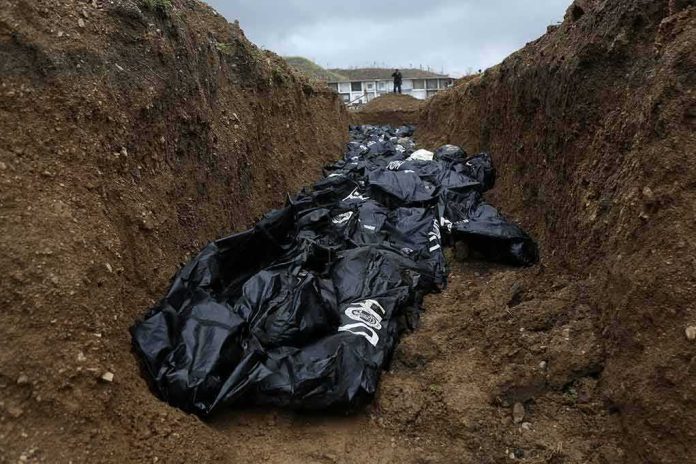
Families in Gaza City buried 100 of their own on Sunday, nearly three years after an Israeli strike buried them first under the rubble of their own homes.
Story Snapshot
- Palestinians held a funeral procession in Gaza City’s Zeitoun neighborhood for 100 people pulled from collapsed buildings.
- The dead came from five families: Rahim, Balawi, Malaka, Qanbour and Salmi, killed when homes were struck roughly two and a half years ago, according to local authorities.
- Middle East Eye reported 62 of the 100 were children.
- Local crews worked with the International Committee of the Red Cross, using excavators and bulldozers to recover remains before burial at a Zeitoun cemetery.
What Happened In Zeitoun
Mourners gathered Sunday in Gaza City for a mass funeral unlike most news cycles ever cover. One hundred people, recovered from beneath flattened homes, were carried together for burial. Al Jazeera’s field report named the dead as members of the Rahim, Balawi, Malaka, Qanbour and Salmi families, killed when Israeli forces struck several residential buildings about two and a half years earlier, according to local authorities.
The Palestinian news agency WAFA described the burial site as the Martyrs Cemetery in al-Zeitoun, southeast of Gaza City, where the remains went into the ground after being pulled from homes destroyed in the war’s early months. Other outlets, including Middle East Monitor, named al-Ahli cemetery as the burial ground following funeral prayers. Either way, the location sits in the same devastated neighborhood where entire blocks collapsed under bombardment years ago.
Children Made Up More Than Half The Dead
The human weight of this funeral falls hardest on its youngest victims. Middle East Eye reported that 62 of the 100 recovered were children, a detail that turns a wartime casualty count into something closer to a generational loss. TRT World reported that Gaza’s Civil Defence and community representatives delivered memorial addresses before the remains went to al-Ahli cemetery for burial.
Recovering bodies buried under collapsed concrete for years takes real machinery, not shovels. WAFA reported that local crews worked alongside the International Committee of the Red Cross, bringing in excavators, trucks, bulldozers and other rubble-removal equipment to reach the remains. Middle East Monitor reported Civil Defence teams pulled the bodies out in recent days, as part of a second recovery phase in a broader project launched July 19 to find Palestinians still buried under collapsed buildings.
Why The Numbers Keep Shifting
Readers tracking Gaza coverage will notice the death toll isn’t a fixed number. Some reports from the same week cite 100 victims, others 105, and still others 112, often describing overlapping but distinct recovery operations. That inconsistency reflects a brutal reality on the ground: identifying the dead under these conditions is slow, resource-starved work, not a clean bureaucratic process with a single master list.
International humanitarian law calls for examining remains carefully, confirming identity, and documenting findings before burial whenever circumstances allow. In Gaza, forensic experts have called the scale of unidentified remains an “international forensic emergency,” with doctors describing a shortage of DNA labs, scanning tools, and even basic staffing to match recovered bodies against missing-person reports. That gap explains why family testimony and Civil Defence accounts, rather than published forensic logs, carry so much of this story’s weight.
Palestinians in Gaza held a mass funeral for 105 people whose remains were recovered from beneath the rubble of the Al-Taj residential block nearly three years after they were killed. pic.twitter.com/D26vyxd82j
— Al-Estiklal English (@alestiklalen) October 1, 2026
None of that uncertainty changes what happened Sunday in Zeitoun. A community buried 100 of its own, grieving losses that trace back to strikes from roughly two and a half years ago. The exact tally may shift as recovery work continues under the July 19 project, but the scene itself, mourners, Civil Defence crews, and a cemetery filling with names, stands as documented fact. Gaza’s dead are still being found, and every funeral like this one is a reminder that the war’s full toll was never fully counted in real time.
Sources:
youtube.com, aljazeera.com, nbcnews.com, lusa.pt