

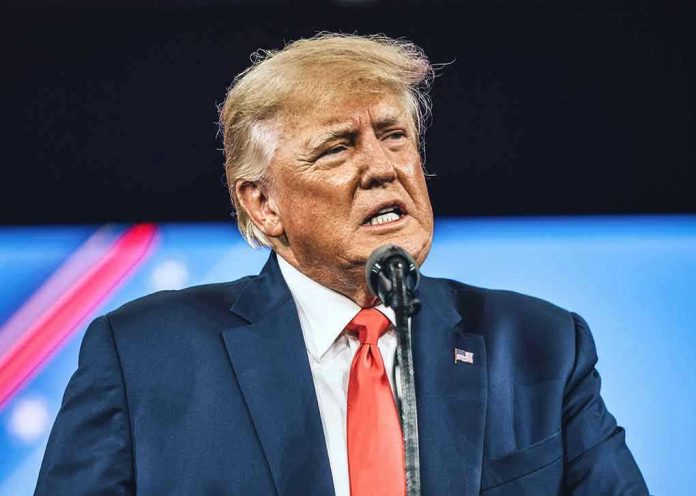
The Trump administration is exploring something that would have sounded unthinkable just a few years ago — the federal government taking ownership stakes in America’s biggest artificial intelligence companies.
Story Snapshot
- President Trump confirmed his team is exploring government equity stakes in major AI companies, calling it a “partnership in this revolution.”
- The administration already secured a 10% stake in chipmaker Intel, establishing a precedent for government ownership in strategic tech sectors.
- The proposal remains in early discussions — no completed AI equity deal exists yet, and key financial mechanics remain undefined.
- The idea has drawn unusual bipartisan attention, with Senator Bernie Sanders separately proposing a 50% government stake in AI firms.
Trump Floats Government Ownership of AI Giants
Speaking to reporters aboard Air Force One, President Trump said his administration would meet with “all the big” artificial intelligence companies to explore giving the American public equity stakes in those firms. Trump framed the idea as a public benefit arrangement, describing it as a “partnership in this revolution.” The remarks confirmed earlier reporting that senior White House officials had already held preliminary talks with major AI companies about potential government participation.
The proposal is still in its earliest stages. According to CNBC reporting, the government is “considering taking a stake in OpenAI, possibly other AI giants as well,” but no completed transaction exists for any AI firm. Critical financial details — including whether the government would receive dividends, voting rights, warrants, or operate through a sovereign-wealth-style vehicle — remain publicly unspecified, leaving the economic structure of any deal an open question.
Intel Deal Sets the Template
The White House points to an already-completed arrangement as proof of concept. The Trump administration secured a 10% stake in chipmaker Intel, and the White House reports Intel’s stock has roughly doubled since the deal was struck. The Center for Strategic and International Studies (CSIS) describes the administration as “acquiring a strategic portfolio of investments in companies directly related to national security,” placing this AI discussion within a broader shift away from traditional grant-and-subsidy industrial policy toward direct government ownership.
However, the Intel model comes with governance complexity that raises legitimate questions. According to the Center for Strategic and International Studies, the government holds its 9.9% Intel stake with no board seat and votes its shares in alignment with the board on most matters. Whether that structure can be cleanly ported to frontier AI laboratories — which operate under very different competitive, legal, and national-security dynamics — remains unresolved. No completed equity deal in a frontier AI firm exists to test the model.
An Unusual Moment of Left-Right Overlap
The proposal has produced a rare moment of agreement across the political spectrum, though for very different reasons. Senator Bernie Sanders has publicly backed government equity stakes in AI companies, though his version calls for a 50% government ownership share — a far more aggressive intervention than anything the Trump administration has described. Social media observers noted the unusual alignment, with some pointing out that when Trump and Sanders agree on a policy direction, the underlying idea deserves serious scrutiny regardless of political affiliation.
Donald Trump says US may take equity stakes in AI companies via @FT
https://t.co/Npc4Y9tYWt— David Burton ⭐️⭐️ (@DavidBurton1971) June 6, 2026
For conservatives, the idea warrants careful evaluation. On one hand, ensuring Americans share in the economic gains of AI — a technology heavily subsidized by U.S. defense research and taxpayer-funded infrastructure — has a legitimate national interest argument behind it. On the other hand, direct government ownership in private companies creates real risks: regulatory conflicts of interest, political influence over corporate decisions, and the slow creep of government control into sectors that thrive precisely because they operate free from bureaucratic interference. The Trump administration’s framing emphasizes strategic competition with China and public benefit, but the structural details will ultimately determine whether this is sound industrial policy or a significant expansion of government reach into the private economy.
Sources:
[1] YouTube – Trump says his team will ‘look into’ US taking stakes in AI firms
[2] Web – Lead the World in AI – The White House
[3] Web – Understanding Federal Equity Investments in Strategic Companies
[4] YouTube – U.S. government reportedly weighing financial stake in AI companies